COVER STORY
June 2014
MODERN MINING
19
on the horizon
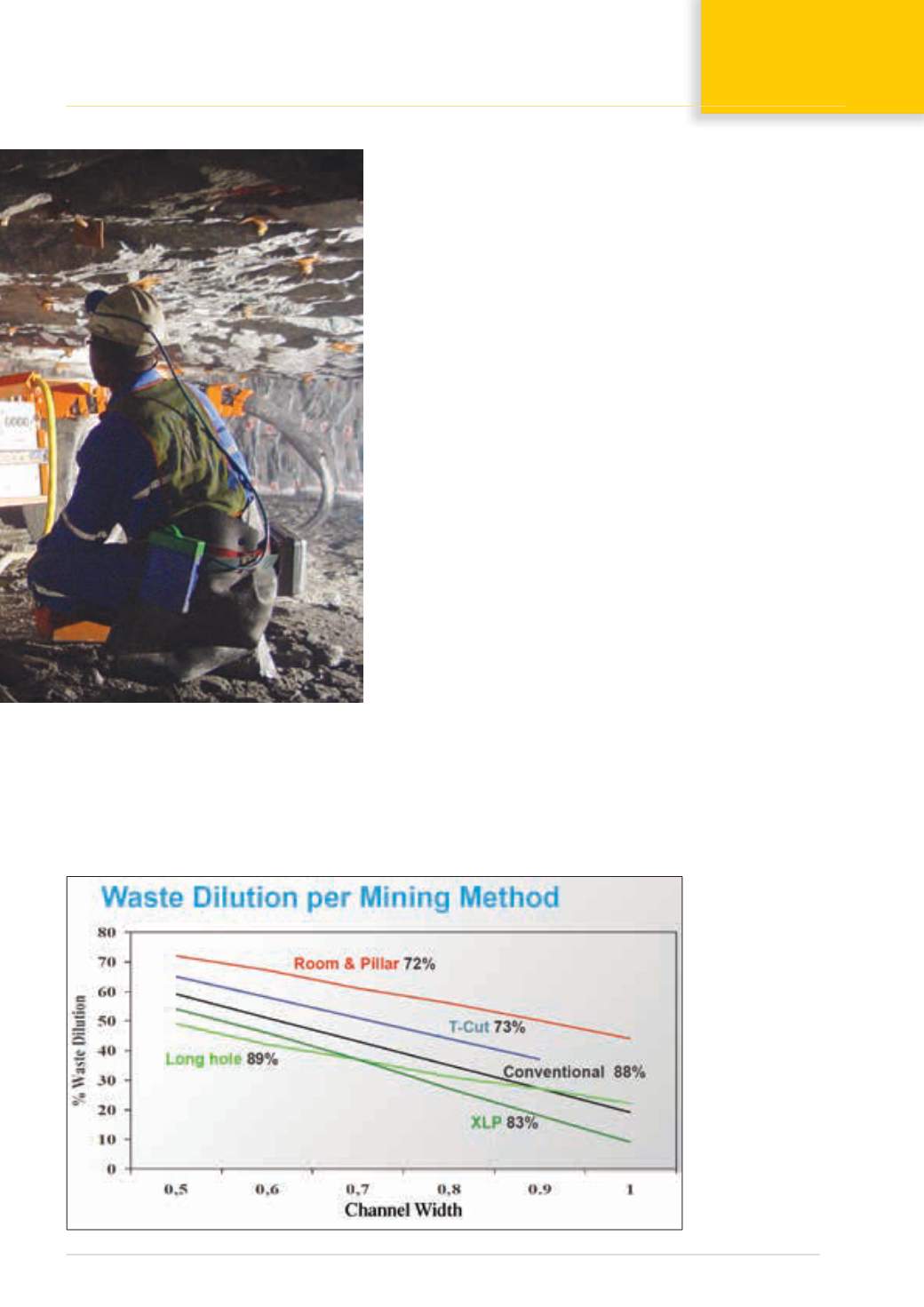
less than 1,2 metres high and are inclined and
uneven. The challenge therefore is to be able to
follow the seam and find ways of extracting the
ore at a similar or better dilution rate to conven-
tional methods.
“In many instances we are ahead of the
game and have developed Extra Low Profile
(XLP) and long hole mining equipment that
can be used in the low profile orebodies of the
Western Limb. In other instances we are using
cutting equipment and other specially adapted
machines and techniques depending on the
geology,” McCoy says.
Global research and development
While there are no generic one-size-fits-all type
solutions available to suit all applications,
Sandvik Mining is working closely with the
industry to find solutions. Research and devel-
opment locally, as well as abroad, is ongoing
and a number of new technologies are being
investigated and tested especially to unlock the
answer to the Western Limb’s dilemma.
Even while new machines are being devel-
oped, another challenge is the development of
skills within the area to implement and drive
mechanised mining techniques. This type
of mining requires more skilled and higher
paid operators, but from a safety perspective
one is removing people from the higher risk
areas to a protected environment in the cab of
a piece of equipment. Supervision skills will
also need to be developed from managing tra-
ditional batch-type operations to continuous
operations that are made possible through the
new techniques.
“A stumbling point is that mechanised mines
require less workers at the face,” says McCoy.
"The challenge
therefore is
to be able to
follow the seam
and find ways
of extracting
the ore at a
similar or better
dilution rate to
conventional
methods."
Neil McCoy,
Sandvik Mining
of the high dilution rate of waste rock and ore
when using similar equipment to that used on
the Eastern side. Here orebodies are generally


