June 2014
MODERN MINING
25
PLATINUM
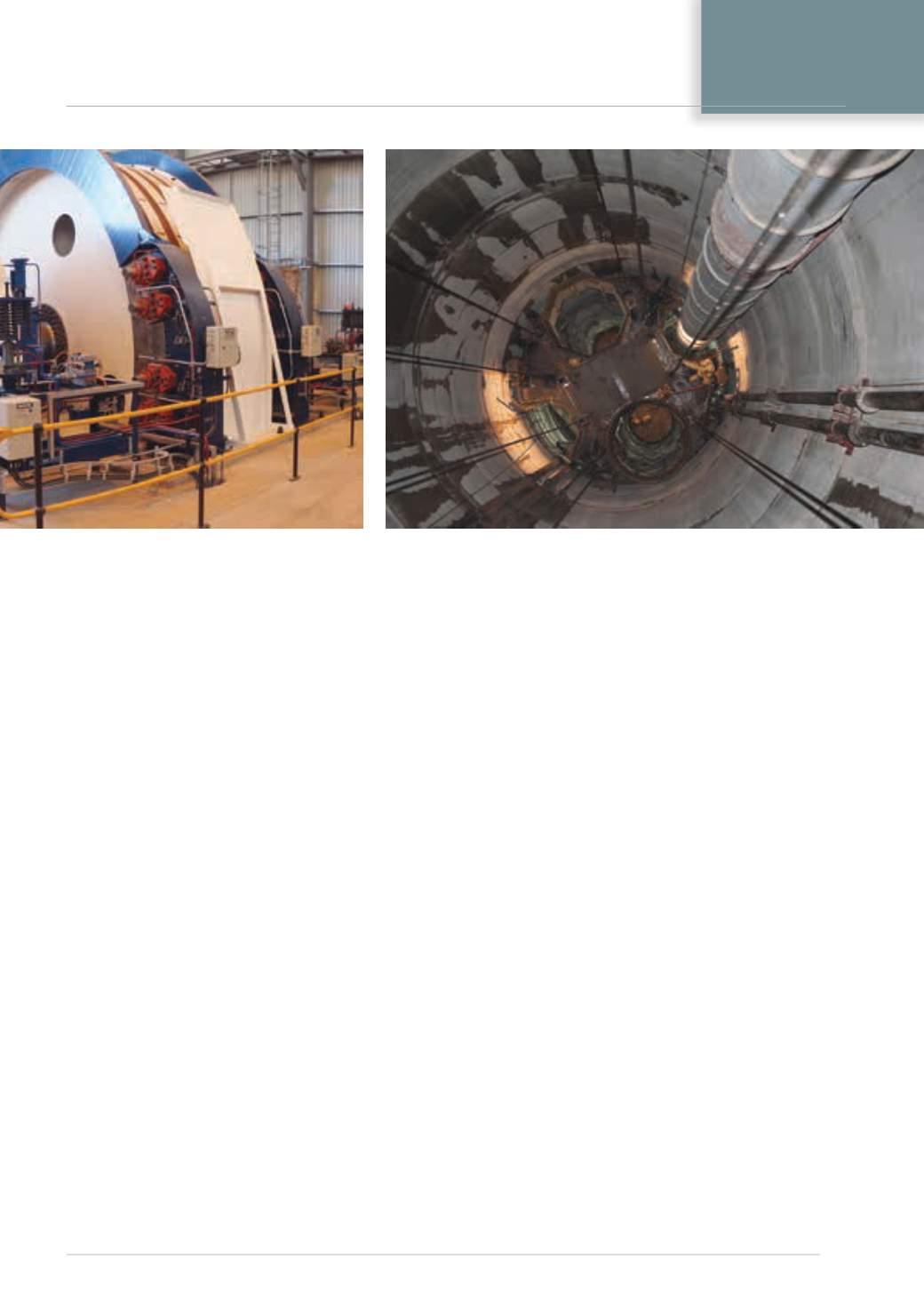
Looking down the Ventila-
tion Shaft, which will even-
tually be sunk to a depth of
880 m.
has increased from 251 000 tonnes per month
to 265 000 tonnes per month and horizontal
tramming capacity is now plus 265 000 tonnes
per month. Bulk shift capability has increased
from 1 000 to 1 800 persons per hour. There is
vehicular access to within 18 m of any work-
ing place and shorter travelling distances to
remote faces.
The multi-level layout and the auxiliary
shaft will allow all mechanised development
and stope panels to be blasted twice a day –
as opposed to a single blast per day in most
operating mines. The advance per blast will be
increased by 10 cm through the use of longer
steel. The twin haulage system enables multi-
blasting to expedite critical development as
may be required.
Talking to
Modern Mining
at the recent
media visit, Wesizwe’s Project Executive,
Jacob Mothomogolo, who has been intimately
involved with the project since 2008, said the
shortening of the shafts would allow sinking
to be completed 85 days earlier than originally
envisaged in the case of the Main Shaft and 72
days earlier in the case of the Ventilation Shaft.
“This is primarily a function of the fact that the
new mining layout allows the Main Shaft to be
reduced from 1 000 m to 940 m in depth and
the Ventilation Shaft from 930 m to 880 m,”
he said. “At this stage, we are forecasting that
sinking of the Main Shaft will be complete by
October next year with the Ventilation Shaft
following in November 2016, allowing us to
prepare for development and commissioning
of the shaft infrastructure.”
As part of the optimisation, a third shaft has
been added to BPM’s infrastructure. “This will
be a 6 m diameter, 720 m deep shaft which will
give extra capacity for men and materials,” said
Mothomogolo. “The interesting point is that we
are planning to raise bore it, which represents
a very efficient approach in terms of time and
money. The new shaft will only be needed
towards the end of the development phase, so it
will probably only go out to tender in late 2016.
Shafts of this diameter have been successfully
raise-bored in the past so we are quite confident
that there is zero technical risk.”
Discussing labour issues, Mothomogolo
said Wesizwe and its contractors were enjoy-
ing great success in recruiting and training
local people to work on the construction of
the mine. “Around 30 % of the 700 to 800
people currently on site – the figure varies
constantly – have been recruited from within a
50 km radius of the mine, with many of them
from the immediate vicinity – within a 2 km
radius,” he said. “Some of them are working
on the demanding and highly skilled task of
shaft-sinking, which bears testimony to the
effectiveness of the training programmes put
in place by Wesizwe and Aveng.
“Once the mine is in operation, we would
hope to see the majority of employees – at least
70 % – recruited locally. BPM has a life of
around 30 years and we believe it is essential
that the local community take ‘ownership’ of it
and benefit from its operations. We are working
steadily towards this goal and believe that our
employment policies, in conjunction with our
very pro-active community relations strategy,
will ensure Bakubung’s long-term success.”
Photos courtesy of Wesizwe (unless otherwise
acknowledged)
“Once the mine
is in operation,
we would hope to
see the majority
of employees
– at least 70 % –
recruited locally.”
Wesizwe’s Jacob
Mothomogolo


