African Fusion speaks with Keegan Govender, QA Manager at GENMAC (Pty) Ltd, about the niche, customised manufacturing and construction solutions offered by the company’s ISO 3834-2 certified facilities in Richards Bay, KwaZulu-Natal.
Click to download and read pdf
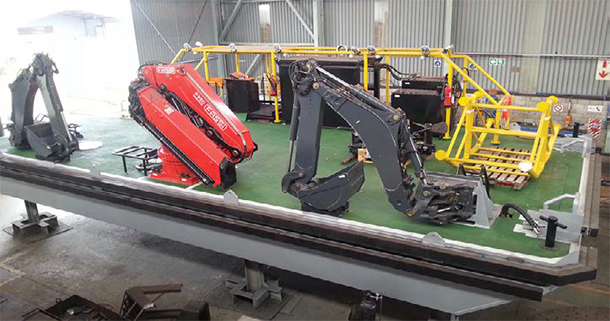
A GENMAC-manufactured and supplied barge equipped with two back actors, a crane for loading and offloading plant equipment, a full hydraulic system and a Z-Drive for propulsion.
Keegan Govender, the Quality Assurance Manager of GENMAC (Pty) Ltd, studied Mechanical Engineering, specialising in structural design. “Before I joined GENMAC, I was at a local Titanium Dioxide plant, also as a quality manager, but with additional responsibilities on the ecology side,” he tells AF. He also holds an Outcomes-Based Assessment qualification from the Assessment College of South Africa, Welding Inspection Diplomas from SAIW in SANS 347 & PER Regulations, and for the Overview of ISO/SANS 3834 Part 2 course.
In 2002, GENMAC opened its Fabrication Workshop facilities in Richards Bay. Together with Directors Govy Govender, Keelan Govender and the rest of the Team, the company strives to maintain its mission statement: ‘To uphold and maintain a leading reputation by providing a quality service with the highest levels of professionalism, integrity, honesty & fairness to all stakeholders’.
A niche customised offering
“The good thing about our business is that it is so specialised. We perform Fabrication work on large structures, such as furnaces, pontoons, barges, pressure vessels, cranes, and conveyors, to meet the needs of minerals-handling and mining supply companies, including the Richards Bay Coal Terminal (RBCT), Rio Tinto, Sandvik, Metso, Tronox and many more, including cross-border companies.
Increasingly, though, a lot of the work passing through GENMAC’s Richards Bay workshops is for local and cross-border clients. He cites a recent success story for maintenance barges for a mineral sands operation in Senegal and Madagascar: “These are used to service the mines’ floating plants, which are pumping mineral-rich sands such as Ilmenite (FeTiO3) from the ground. “We build the floating maintenance barges for moving equipment from the shore to the floating plant and back to shore,” Govender says.
This work involves significant structural fabrication, including plate work for the watertight hulls. “We also make conveyor systems, piping, safety walkways and stacking solutions for floating plants, pontoons and the barges that service them,“ he adds.
On the pressure-vessel side, he says that pressurised vessels are used to transport the titanium-rich, heavy material to shore. “There are two ways to transport mined material to shore: using a conveyor system or by loading the material into a pressurised vessel and then transferring it to shore via a pipeline,” he says.
“The barges we manufacture are fully equipped. The small one for Madagascar is 8 meters long and 4 meters wide. It has a full set of on-board hydraulics, a small crane, a skipper’s chair, propulsion systems, controls and a rudderless Z-drive propeller for manoeuvrability. It’s a purpose-built vessel for servicing floating mining plants,” he points out.
An interesting larger version was also manufactured for Senegal and delivered towards the middle of 2025. The 15×8 m barge had to be delivered from the Richards Bay facility to the Port of Senegal and then 21 km overland to the mine, passing through a residential area with an access limit of 6 m. So we had to manufacture the barge in two sections for transportation, then send a crew up there to weld the sections together, pressure-test it and float it to the mine’s pond.
“That barge is also equipped with two back actors, which are used to hold the barge to the shore during loading or unloading, and an on-board crane for loading and offloading pumps and anything else required for the plant,” says Govender, adding that “every application is different, so all of our work is uniquely customised to best suit the designs and needs of the plant and the customers’ requirements.”
“GENMAC has been specialising in barge manufacturing for several years, and as a result, we have now made it easier for our customers. Customers can now order our small, medium, or large barges, and we will then spec them to meet their specific requirements,” he tells AF.
GENMAC’s Richards Bay facilities
From its Richards Bay facilities, GENMAC has the manufacturing capacity to process 200-250 t of steelwork per month. “Our facilities sit on 5,000 m2 of land, with 2x1,000 m2 under-roof workshops. For heavy fabrication, our first workshop is served by two 10-ton cranes and a 5-ton crane, where our welders and boilermakers manufacture and assemble various structures and components.
“Our second workshop, with one 5-ton and a 2-ton crane, is a fully fledged machine shop, where we machine various types of components”, he says.
The value of ISO 3834-2 accreditation
Since February 2025, GENMAC has been an ISO 3834-2-certified company under SAIW’s Welding Manufacturer Certification Scheme. “We have also held ISO 9001 and ISO 45001 accreditation for many years before that,” he says.
“We like ISO 3834 because it is welding-related. The step-by-step processes you need to follow to ensure weld quality are made clear from the beginning. For much of our business, this certification is not necessary, but our clients are now interested in it. We showcase its value to them, with respect to better confidence in the quality produced and better traceability of the processes, procedures and materials used. It helps clients to understand welding as a complex process that has to be tackled in the right way from start to finish,” he says.
“It also helps the welders to understand the whole welding process. I can tell the welder what needs to be done, and during the process, we put monitoring systems in place to ensure every aspect of a welding task is carried out thoroughly. At the end of the process, NDT and further quality checks kick in before we send anything to the machine shop or painting plant,” he notes.
“ISO 3834 ensures that welding is done as a more in-depth, holistic process, which ensures much better results. On the quality side, problems can be detected much earlier, preventing costly rework. And regarding customers, we can call them in to witness each quality hold point, to demonstrate what we have done, prove we are on track, and provide an opportunity to take part in negotiations on how to take a project forward,” Keegan Govender tells African Fusion.
Regarding SAIW’s role in auditing and managing GENMAC’s ISO 3834 accreditation, he is very satisfied. “From their side, the SAIW has been excellent, and we don’t have any issues. Shelton and his team are a phone call away. But if they are unavailable, they always call back and are always helpful.
Welding choices and training
Since no two welding projects are ever the same, GENMAC prefers manual welding using the semi-automatic GMAW and flux-cored processes. “Manual processes are easier and quicker to implement and control, because robots and mechanised systems all need to be programmed, which takes longer for the type of work we do. We are shifting more and more towards using flux-cored welding wires, though, which, compared to solid wire GMAW, now accounts for 50% of our consumable use,” he adds.
Regarding brands, he says that while premium welding brands such as ESAB are preferred, some clients have their own brand preferences, which GENMAC is happy to accommodate.
To retain and develop welding and boiler-making skills, GENMAC runs an apprenticeship training programme, using its own skilled welders to upskill and mentor young talent. “As well as being employees, we train our people here, and when they are ready, we send them for their welding or boilermaker trade tests.
“It takes about 2 years to train a learner, and they must first complete various theory modules. Once they get shop floor sign-off for their practical abilities, then we can start the process of getting them qualified as Red Seal artisans,” he explains, adding that being a qualified assessor helps him to negotiate the paperwork required by apprentices to satisfy trade test requirements.
The future outlook
There are several titanium companies in the Richards Bay Area that all have expansion and local beneficiation plans in place. “Operations are also expanding, so we are very optimistic about future work.
“We are a quality-driven company, and we are fully committed to Richards Bay and its youth development. One of our subsidiaries invites youngsters from our local rural areas to training programs in swimming and sailing, ranging from small boats to large mono- and multihull sailing boats.
“At GENMAC, we make the structures often featured on the DStv show presented by The Engineer, and we make these products with commitment to safety, quality, the environment, customer satisfaction, employers and the Richards Bay community,” concludes Keegan Govender.