In this white paper, voestalpine Böhler Welding highlights, through case studies, the advantages of moving away from manual welding by adopting more automated solutions, using solutions such as the company’s CO-BRO® FLEX collaborative robot, or mechanised solutions, such as railRunner.
Click to download and read pdf
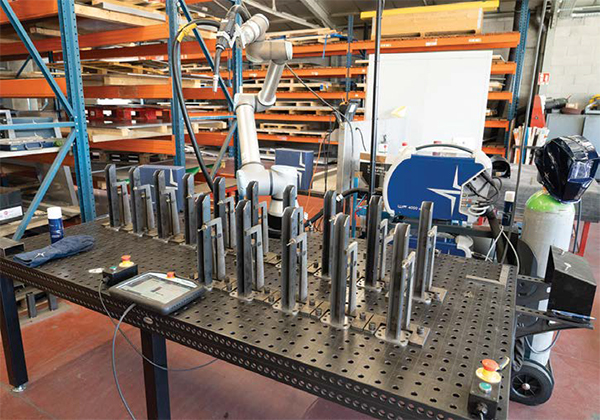
Böhler Welding’s CO-BRO® collaborative robotic solution, using the Uranos NX 3200 GSM welding power source, is in use, welding 250 to 400 brackets per day.
Raising productivity at high-complexity levels, while meeting high-quality, flexible production and tight scheduling requirements are universal modern-day challenges for the welding industry.
Additionally, tough competition, along with growing skill and competence shortages, is driving a shift towards automation in this industrial sector. It should also be noted that optimum productivity does not only require the highest possible welding speed, but also fast setup, low downtime and high reliability.
As a trusted partner for automated welding solutions, voestalpine Böhler Welding supports fabricators worldwide in mastering their transition to automation with confidence and technical excellence.
With smart integration options, user-friendly interfaces, data-driven quality management, and global technical support, productivity gains can be achieved effectively. Whether starting with light automation, exploring collaborative robotics, or scaling to high-performance industrial robotic welding, voestalpine Böhler Welding can deliver the tools and knowledge to transform production from manual to automated welding.
Collaborative robotics
For fabricating components in small batches in facilities where flexible production is the norm, industrial robotic solutions are seen as unattractive to welding shops because they are not versatile enough. Running a robotic welding cell requires significant setup time and program fine-tuning, which is only feasible for high-volume production cycles. There is an alternative, however, the collaborative robot.
The main difference between industrial robots and collaborative robots lies in how they interact with operators in the work area. Due to the lighter weight and slower arm movement of a collaborative robot, the operator can access the working area during operations, directly move the arm to create a welding program, establish weld-path points, and make position adjustments. Consequently, collaborative robot solutions are ‘plug and play’. They are easy to move around the workshop to meet the needs of different welding tasks.
A CO-BRO® FLEX success
As an example of a typical and successful collaborative robot user, one of voestalpine Böhler Welding’s customers provides turnkey manufacturing solutions for more than 100 different types of small- and medium-sized steel components. The company implemented Böhler Welding’s CO-BRO® collaborative robotic solution using the Uranos NX 3200 GSM welding power source in its manufacturing facility.
After a few hours of programming, using the Böhler Welding PulseDrive pulsed arc welding process, it was possible to increase bracket productivity from 250 to 400 pieces/day while maintaining high quality and reliability.
Light automation for longitudinal seams
Böhler Welding also offers wheeled- and track-based carriages for longitudinal seams, ideal for large tanks, beams, frames and shipyard applications. Typically, these solutions can reduce welding time by up to 90% compared to manual welding, particularly when using Bohler Welding’s fully mechanised railRunners combined with flux-cored wires in the vertical-up position. This level of productivity is also achievable for longitudinal weld seams on larger tanks.
In a welding study involving a 9% Ni consumables for use on LNG storage tanks, butt welds in the vertical-up or frontal positions were usually completed using SMAW. Manual welding for these applications is associated with clear limitations, however, due to the following issues:
- Frequent interruptions to exchange the stick electrodes and for slag removal.
- Material waste and the associated high cost of welding consumables.
- Skilled manual welders are necessary.
- Repeatability and meeting the requirements of established WPSs are seldom ensured.
To overcome these issues, GMAW and FCAW semi-automatic solutions have been adopted over the past few years, resulting in significant improvements across all the limitations mentioned above.
Flux-cored wires featuring a fast–freezing slag system to support the weld pool proved to be the most reliable and efficient welding consumables for positional welds on LNG tanks. The deployment of semi-rigid and flexible track-type mechanised welding carriages, in combination with flux-cored wires, resulted in a further enhancement, resulting in the benefits below:
- Higher production efficiency.
- Deposition rates as high as 85-90%: 5-8 times higher than that of SMAW.
- No electrode wastage.
- Higher weld quality.
- Greatly reduced numbers of stops and starts.
- Minimised critical weld failures and rework.
- Eliminated almost all weld grinding and cut-outs.
- Less welding skill is required.
- Mechanised equipment maintains precise control of the welding parameters.
Modelling time and material efficiency for a typical butt weld of a 9% Ni steel LNG tank with SMAW, one may realistically achieve a process duty cycle – arc-on time vs total time – of about 20%, with a 1.5 kg/hr deposition rate and material losses of about 30% or more.
Based on those assumptions, as shown in Table 1, for a typical case of 25 mm plates with an X weld preparation, calculations for the SMAW process yield a total manufacturing time of 468 min and 3.34 kg of welding consumables per 1 m of welding.
In the case of the Böhler Welding mechanised solution, the process duty cycle can reach up to 80% for longitudinal non-interrupted welds, with a deposition rate of 3.4 kg/hr and a material efficiency above 90%. That leads to a very interesting scenario: the time to completion is only 49 min, compared to 468 min with SMAW, which is nearly 10 times faster. In addition, consumable material usage is 2.6 kg, more than 20% less.
Table 2 provides details of the assumptions and calculations for SMAW, semi-automatic FCAW, and mechanised FCAW using railRunner.
Conclusions
Whilst selecting the correct equipment in combination with the correct welding consumables is essential to achieve these concrete benefits, synergic lines built into the welding equipment, tailored for use with the specific welding consumable products, in addition to the expertise offered by the welding solutions provider to overcome challenging welding applications is what ultimately makes the real difference between achieving the ‘Perfect Weld Seam’ or not.