On 20 September 2024, Eskom and Sasol signed a landmark agreement to work together on exploring LNG (liquified natural gas) sources and potential market uptake – a move that is set to reshape South Africa’s energy landscape and mitigate the imminent gas shortage the country is facing. With the official signing of the Memorandum of Understanding (MoU), Eskom and Sasol commit to collaboratively exploring gas-to-power applications – as a transitional technology in the country’s drive towards clean energy – and to enabling South Africa to find a solution that assures gas users of secure longer-term supply beyond this decade.
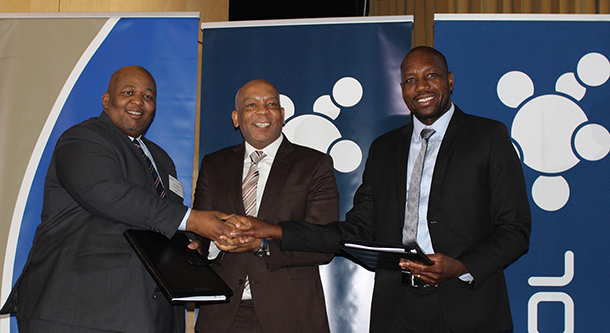
From left: Eskom Group Chief Executive Dan Marokane, Minister of Electricity and Energy Dr Kgosientsho Ramokgopa, and President and CEO of Sasol Simon Baloyi, at the signing of the MoU.
Together, in an intensive initial phase of research and planning, they aim to determine the potential volumes that South Africa requires to establish a viable LNG import market, along with the enabling infrastructure. This will be facilitated by government-to-government relations where necessary. The initiative focuses on using gas for power generation to provide essential baseload electricity and position gas as a key enabler of re-industrialisation, and at the same time, ensuring continued supply to the market by unlocking LNG resources internationally. Furthermore, the collaboration will contribute to enhancing South Africa’s energy mix and support the country’s energy transition and decarbonisation.
The MoU was signed with the full support of the Minister of Electricity and Energy, Dr Kgosientsho Ramokgopa. Speaking at the signing ceremony, the minister said: “We have made it clear that we are serious about LNG solutions for the country, and our demand for gas across both industrial and energy frontiers will unlock these solutions. This collaboration between our two energy champions – one public, one private – will provide a data-driven and commercially sound basis for gas-fed industrialisation and for us to explore the well-worn path to lower carbon energy that the global north has already taken by scaling gas to power. Gas has emerged as the second largest contributor to global electricity production, seeing rapid growth as many countries shift from coal to gas in their energy mix to enable positive impacts on climate change, as gas typically emits less CO2 per unit of energy (compared to coal and other fossil fuels).”
Aligned to the Gas Masterplan, the MoU provides for exploring gas sources within South Africa, the Southern African Development Community (SADC) region, and other parts of the African continent, in addition to evaluating long-term LNG contracting. This will support the gas requirements for Eskom’s planned coal power station repowering and conversion to gas in the long term. The parties will also engage other state entities to enable an LNG value chain in South Africa.
As part of its revised gas strategy, Sasol is working on enabling the future supply of LNG to South Africa by collaborating with companies such as Eskom, existing and future customers, suppliers, and infrastructure developers.
The research findings from the first phase of the Sasol-Eskom collaboration will guide the relevant role players and required investors to offer the best prospects for South Africa’s energy market and will indicate the challenges associated with the long-term commitments required for LNG imports.
Simon Baloyi, President and Chief Executive Officer of Sasol said: “As a leading energy player in South Africa, we are excited to collaborate with Eskom to transform the regional energy landscape. By leveraging our combined technical, operational and project execution expertise, we are committed to enhancing regional energy security and driving development. In doing so, we will unlock new growth opportunities and help drive the transition to a more sustainable energy future for our country.”
There is clear alignment between Sasol and Eskom in exploring LNG supply as an enabler of this vision.
Dan Marokane, Group Chief Executive for Eskom said: “As the two largest users of coal in South Africa, we have a great deal of experience, and we felt by working together we could accelerate the energy transition in a responsible way which sets the country up for the best economic, environmental and social outcomes and addresses the imminent gas supply shortfall. Eskom is focused on a balanced and diversified energy mix based on existing coal and nuclear and introducing gas for baseload power, as well as renewables and energy storage systems, including batteries and pumped hydro, to achieve overall security of supply and to meet and exceed rapidly expanding energy demand,” he said.
For more information visit: www.eskom.co.za