The Gauteng Foundry Training Centre (GFTC) – the only Quality Council for Trades and Occupations-accredited trade test facility and the only public facility in South Africa – is firing on all cylinders again after a period of scaling back some of its training endeavours due to post-COVID financial refocusing.
Click to download and read pdf
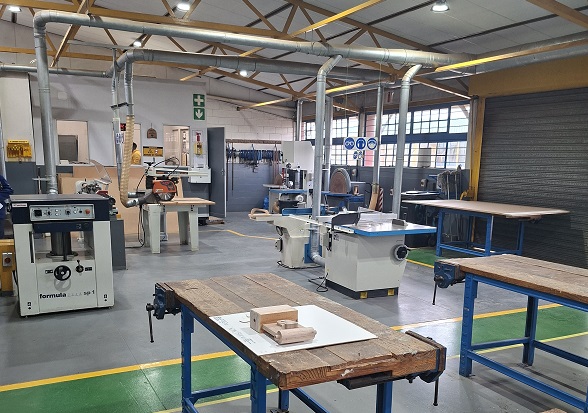
The GFTC’s pattern-making shop: The college is introducing digitalisation, with employees moving from manual design to computer-aided design.
The GFTC was established in 2013 as a collaboration between the Gauteng Department of Economic Development; the South African Institute of Foundrymen; the Ekurhuleni East TVET College; the National Foundry Technology Network (NFTN); and the Department of Trade, Industry and Competition. It is administered by the CSIR (Council for Scientific and Industrial Research).
Training modules focus on pattern making, moulding and melting. These are crucial skills for the foundry sector, which is the backbone of the steel manufacturing industry. Sandy Majatladi, NFTN Manager, says, “Just looking at moulding, for example, it is the foundation of every casting process: if you get that wrong, the end cast product is compromised. Formalised and accredited skills in these areas that consider both the theory, including the processes, and the practical execution are an imperative to sound quality, competitive products.”
Errol Beling, Training Centre’s Head of the Occupational Programme, says the GFTC “maintains the standard as high as it should be, aligning with the general developmental and foundry needs of industry”.
All three focus areas have been accredited, and the Kwa Thema campus has seen 56 pattern makers, floor moulders and melters completing their training. They have been placed in companies for their work-based experience part of their training, and, since these are scarce skills, especially pattern making and moulding, most of the graduates have been absorbed into the industry.
While the Kwa Thema campus was selected as the venue for the GFTC due to its proximity to industries relying on foundries in Gauteng, course participants are sent by their companies for trade testing from as far as Cape Town, Port Elizabeth, Durban and Kimberley.
“We have had several people apply to do their recognition of prior learning (RPL) through the GFTC. They initially apply through the sector education and training authority for an RPL, who then refers them to us for a pre-assessment. If additional training is needed, we set that up for them. These are people who might have decades’ worth of practical foundry experience without formal training,” Beling continues.
He adds that age is not an issue. Young people start their training before employment, while the more established – the oldest participant thus far was 64 years old – polish their skills and benefit from the accreditation that, in turn, strengthens skills development, quality improvement and the competitiveness of the whole industry.
Industry support
Comments from Industry summarised the importance of skilled artisans and technicians in this field: “These trades are integral to South Africa’s economic drivers, particularly within the manufacturing and engineering sectors. Foundries form the foundation of numerous value chains, supplying essential castings for mining, automotive and heavy-industry applications. Without skilled moulders, pattern makers and melters, the ability to produce accurate, high-quality castings diminishes, thus creating a ripple effect that weakens local manufacturing competitiveness and increases dependence on imports. The continuation of accredited apprenticeships and learnerships in these trades is essential for ensuring a future talent pipeline.”
These views are echoed by industry stakeholders, who emphasise that foundries play a critical role in job creation and occupy a unique position within the manufacturing sector. There is a continued demand for accredited training aligned with modern technologies and sustainable practices, with skills development seen as a key driver of employment and enterprise development across the value chain.
Just sign up
Majatladi explains that the reinvigoration and reinvestment in the GFTC are in response to the need for skilled artisans and technicians in these areas, as well as to positive feedback from companies that have either employed GFTC-trained apprentices or sent their employees for upskilling and accreditation.
The drive to train or upskill employees, who are then accredited and undergo an apprenticeship upon completion of their training, is essential for the sustainability of the foundry sector, not to mention the benefit to the individuals, who leave the GFTC with proof of having gained vital formal skills.
“This is a service to foundries at no cost to them. Foundry managers just need to send their people for training to begin enjoying the many benefits of well-skilled artisans. We are also encouraging the youth to pursue careers in the foundry industry. It has been known as a dirty, dusty and risky career, but it is not anymore; technology has brought along many improvements.”
What to look forward to
The GFTC is introducing digitalisation within the pattern-making field, where employees will move away from manual design to computer-aided design. “This will enable the foundries to align with state-of-the-art technologies that competitors are using globally. Business is moving faster, and for us to be efficient, we must align with industry norms. In addition to that, we're also adding foundry consumables knowledge, while ensuring that students receive relevant, adequate and practical training, along with knowledge and familiarity with the personal protective equipment used during their practical work, which is critical for employee safety,” Majatladi says.
“The foundries that are now in business are foundries with the right skills in place. Those are the foundries that have appointed highly skilled metallurgists; hence our drive for skills and upskilling among foundry employees across the sector. Successful foundries appreciate the value of proper skills.
“As a result, our three-year focus starts with the right foundation. We are developing melters, moulders and pattern makers to ensure the basics are right from the start. The next phase will introduce machine learning, although we have already begun with some elements, to enable foundries to respond to and record real-time data. This is quite critical, especially in sectors such as automotive, where, when they encounter product-defect recalls, they can respond more quickly because production data is readily available, enabling problems to be eliminated faster and more accurately.
Research, development and innovation to aid rapid response are ongoing, with, among others, product simulation being introduced to identify potential defects in the casting, optimise the gating system, and cut costs by validating manufacturing feasibility before producing the actual part,” continues Majatladi.
“We at the NFTN and the GFTC also understand that, for many foundries, their equipment is ageing and the cost of capital equipment is substantial. However, there are methods and processes in place that enable phased upgrades and integration.
“In addition, we are looking at helping foundries incorporate added value to castings. The majority of our foundries cast and send the ‘as-cast’ product to the supplier or a third-tier supplier for machining. However, adding value to their own castings not only increases their product value but also eliminates defects and reduces turnaround times, because foundries can machine and inspect their products before releasing them from the facility. This also shortens lead times to market.
“We envision fully integrated production facilities with the necessary machining in place. This will be another big plus for localisation – keeping manufacturing in South Africa and not relying on imports, says Majatladi. “We expect this to snowball into employment creation because successful foundries are sure to have a consistent supply of orders to be filled,” he concludes.
https://www.foundry-planet.com/d/gftc-gauteng-foundry-training-center/