
A short distance from Cape Town, nestled against the Bottelary Hills, lies one of Stellenbosch’s historic wine farms: Hazendal Wine Estate. The wine estate combines Russian and South African traditions for a unique winelands experience. Lighting in Design talked to Greg Segal about illuminating the majority of the vast estate.
https://www.crown.co.za/lighting-in-design/case-studies/15731-harmonious-lighting-for-hazendal#sigProIda2e59f9248
Hazendal’s history began when German settler Christoffel Hazenwinkel made his way to South Africa’s Cape. Hazenwinkel was a beadle of the Court and worked as messenger for Governor Willem Adriaan van der Stel, who in 1699 granted Christoffel Hazenwinkel 60 hectares of land in the Bottelary Hills of Stellenbosch. He named the farm Hazendal, which translates from Dutch to valley of the hares.
More recently, Hazendal was bought in 1994 by Dr. Mark Voloshin, the farm’s current owner, and is managed as a family affair. His dream of wanting to preserve the estate’s rich heritage, uplift the local community and create a unique Winelands destination, has added a new chapter to Hazendal’s history.
In 2018, after extensive restoration and redevelopment of the estate, Hazendal reopened as a multi-faceted Winelands destination, bringing together the farm’s rich history and heritage with contemporary design, innovative ideas and a Russian flavour.
Given that Dr. Voloshin’s family reside all over the world, it was his dream to make Hazendal a place where he could reunite with his loved ones, as well as create a destination at which other families could do the same.
His steadfastness in wanting to preserve the estate’s rich heritage, uplift the local community and realise his vision of a unique premium winelands destination gave rise to a massive restoration project.
Hazendal’s architecture
Architecture is defined as “the design of buildings and the space within the site that have as their principal purpose human occupancy or use”. The architecture at Hazendal does just that. Born from a vision of being a destination venue, the design layout, grounds, service and décor are a macro plan filled with multiple micro-experiences. The architectural language places people first rather than dominate the environment with its style. And, as is the case with so many great ideas, the result seems simple and effortless.
When asked to breathe life into their client’s vision of contemporary and exciting new structures living harmoniously alongside 300-year-old buildings, Mike Hackner Architects took up the challenge. Maintaining the integrity of the heritage buildings, while offering state of the art new structures, they have created the elegant, harmonious and seamless blending of old and new that is delighting visitors to Hazendal.
The four original buildings that lie on a northsouth axis on the property gave rise to a linear design language. Their positioning also formed a natural buffer between the public and private spaces on the estate and the focus of the Hazendal community is centred on the heritage werf (a farm homestead and farmyard), which also serves as an elegant foreground for sweeping views over the lake, the pavilion and the hills in the distance.
Paradoxically, the architecture is a study in contrasts and sympathy with the past. The clean lines of the new winery, restaurant, conference facility, admin block and edu-play centre are undeniably modern, yet they are submissive to the old in terms of scale.
Some of the new buildings mimic the shape of a traditional Cape Dutch barn and are clad in a raw stone – a material used in the construction of the original farm over 300 years ago.
Undeniably beautiful, the architecture is also unassuming. And once the eye is caught by one detail, the full beauty and ingenuity of the layout is revealed. The clean silhouette of the pavilion, the height of the dining room and subterranean suites are masterpieces of modernity without being showy. In short, Hazendal’s architecture is a study of historic sensitivity re-imagined for the enjoyment of a contemporary guest.
Q&A with Greg Segal
Lighting in Design caught up with Greg Segal from GS Lighting Consulting, the man responsible for much of the lighting design at Hazendal to find out more about his views on lighting, the challenges he encountered on the project, and how to weave a ‘golden thread’ through the lighting of so many disparate buildings and spaces.
Q: Who is Greg Segal?
A: I am a Johannesburger born and raised. As a youngster, at school, I was involved in drama production on the backstage side and I was also into photography, so I always had a passion for the technical side of lighting and how it affects what we see. As one of the founders of Head Interiors with friends in Johannesburg in the late Seventies, and amongst other logistical aspects, I was the ‘lighting guy’. I left Head after 14 years to move to Cape Town.
Due to my background, I was able to understand what architects and other designers wanted out of lighting, my business plan was to provide an outsource design and supply service to professionals as a lighting practitioner. I was fortunate to be able to work with the late, world renowned, Dr. H Einhorn, on several projects. He was Emeritus Professor of Electrical Engineering and Lighting at the University of Cape Town. I had attended ILESA lighting courses where he was lecturing. He invited me to join his course on Illumination Engineering. This I did and I spent a year of university Wednesdays attending his lectures or working in the lab. This resulted, after the written exams, in my graduating with a certificate in Illumination Engineering from UCT.
In my early years in the lighting industry, I became a member of ILESA and SANCI. These merged in 1994 to become IESSA (Illumination Engineering Society of SA), and I am now a ‘fellow’ of the society.
You could say the lighting has been my passion for many years and I get great satisfaction from seeing projects when finally completed. The key word has always been ‘seeing’ and this is true today as lighting and ‘seeing’ are one and the same complex thing.
Q: How did you get involved at Hazendal?
A: My method of marketing with professionals is all by network interaction. Two architects, who were both working on projects at Hazendal, approached me because they wanted to have the relevant lighting knowledge and skills on the project. I also have an excellent working relationship with Paul von Zwicklitz, of Lewis & De Kroon, the Electrical Engineer, retained by the client to engineer the entire electrical requirement on the estate. We approached all the new lighting requirements as a team.
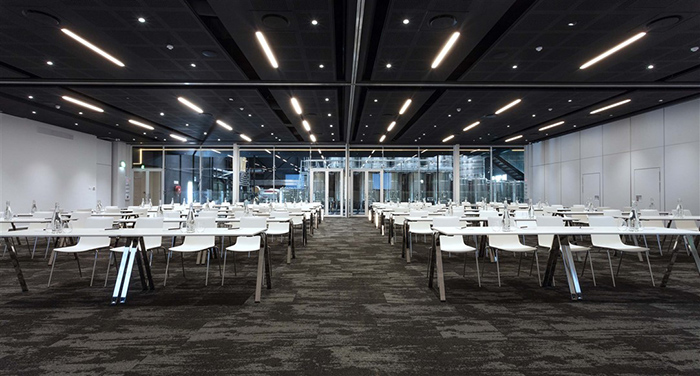
I started on the lighting plan for a new double volume conference centre. Designed by Chris Wood in joint venture with Mike Hackner, it is a multifunctional space with re-configurable areas. Stack away partitions allow for a multi-functional space. Chris wanted LEDs and wanted the lighting to be controlled somehow, but it was a difficult space with black ceilings and dark carpets. I started with a clean sheet of paper as there was no lighting plan at all. I believe that it is good to start from a blank slate, but the first thing you need to do is drill down into the mind of the architect or designer. Understand their vision and expectations for the project. Almost a reverse brief, I extract it from them by talking about lighting. Obviously, there are standards and a technical requirement for the lighting design. This is applied in the background. I keep these conversations technical to a point.
One of the things I do, is apply Richard Kelly’s design approach and look at three elements of light:
- Ambient Luminescence. This is the first fix requirement to bring the light level up to general suitable background feeling (and technical requirement for whatever the function of the space may be).
- Focal Glow. This will be areas and pools of light that are brighter than the background. This could be several times brighter than the background. The attention of the observer is drawn to these areas. This creates the so called ‘pop’ and visual interest as well as the apparent layering and additional spatial dimension. Light and shadow also add an edge here.
- Play of Brilliance (The stimulation of the spirit). This, in modern terms, may be called sparkle. An acceptable technical term.
This approach is softer than one that is based entirely on engineering and many clients find it much easier to buy into.
Q: Was it a challenge working on so many projects at Hazendal, often with overlapping timelines?
A: There is no project which does not evolve or shift, at Hazendal though, as soon as we were finished with one project – or even in the midst of one – we would start working on the next.
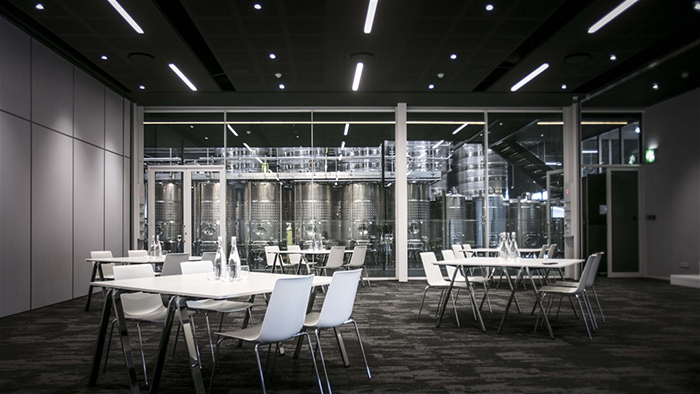
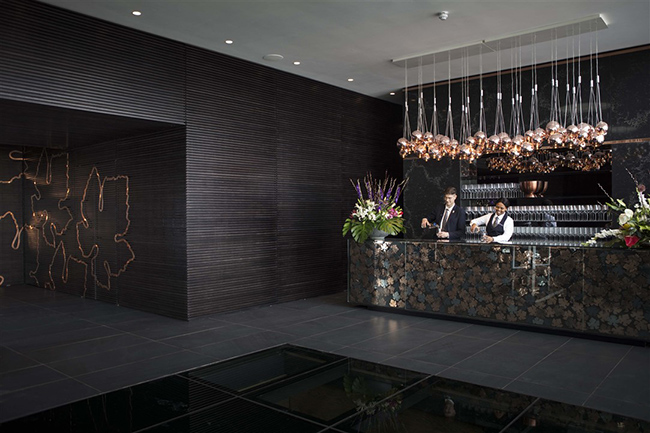
After the conference centre, it was the admin portion of the building (which includes the main winery where you interact with the conference centre through glass partitions). Upstairs is an office level and I did the lighting layouts for all of these spaces. The conference centre lighting is all cutting edge, contemporary and was supplied by RLS.
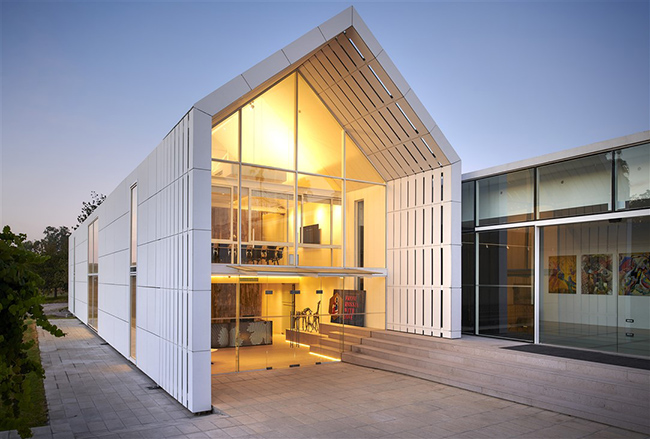
While this was being completed, we started on the wedding pavilion, a new admin block, the Avante Garde Restaurant plus wine tasting rooms and a vodka tasting room which interact with the Avante Garde Restaurant. The admin building needed to talk to the heritage buildings – it is a really beautiful little modern building called The Admin Block.
At the same time the client renovated some of the old farm buildings and opened one up as a deli called Babushka in a renovated old Cape heritage building. We also relocated the Marvol Gallery (here the lighting was done by QDP) and renovated the Manor House, which was turned into a guest lodge (I did the landscape and exterior lighting and QDP did the interiors). One highlight for me is when you see white Wedding Pavilion illuminated at night the … it doesn’t need much light as it is very reflective, but a product from Delta in Europe was the only product that could achieve what the architect wanted.
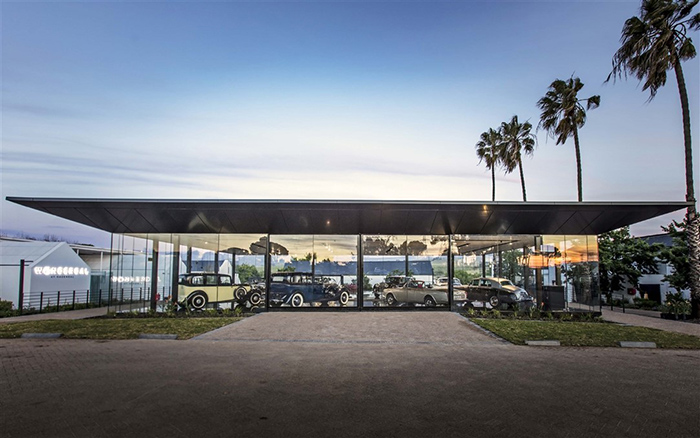
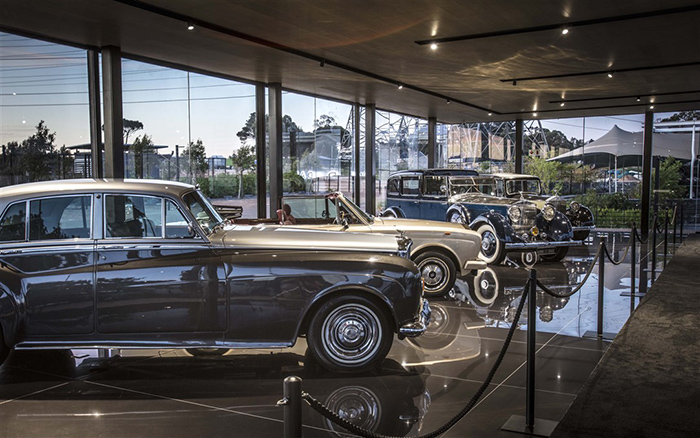
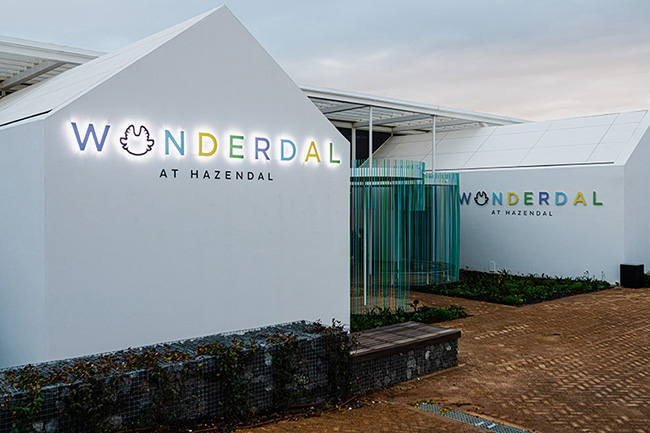
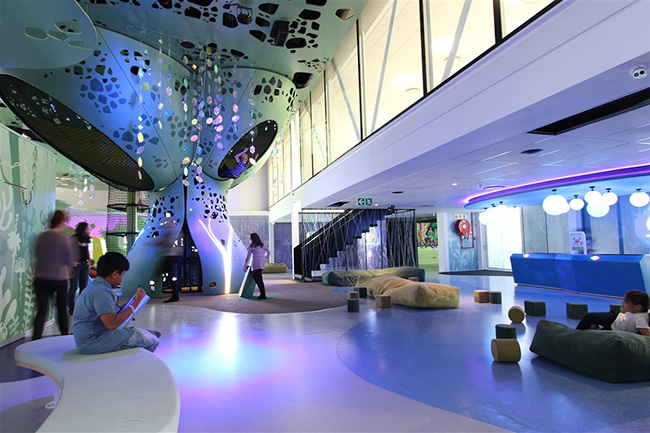
Another phase was Wonderdal, an education and play building where visitors can drop off their kids while they go wine tasting or mountain bike riding. The architects also uncovered the remnants of a 17th century installation which they turned it into an outdoor venue called The Threshing Circle. A glass-walled modern building was then created as an open pavilion for the owner’s vintage cars – it could be a ‘Mies Van Der Rohe’ transplanted from New York into the estate.
There have been about four or five phases, and all the while, the landscape lighting is continually being looked at and improved. Plans for the future include building a boutique hotel on the estate.
Q: Is it possible to have a ‘golden thread’ through so many different buildings?
A: The owners of Hazendal are internationals. They are educated in Europe – the first world – where they understand the value of design. The golden thread through all of the different projects was a golden client, a client that had, in some instances along the way, maybe a bigger vision for lighting than some of the professionals.
Challenges across the projects were primarily getting everybody on the same page, not really budget related. Technical challenges were few and far between because most of the projects were new builds. The landscape lighting installations were occasionally an issue is the area has a moving water table, meaning an area which was bone dry in summer was sodden in winter. Occasionally we did encounter issue with the quality of the installations, especially when they were rushed to get done in time for an opening. Overall, whatever I have done at Hazendal I am proud of and happy to show to people and put my name to.
