


With the mining industry, one of its biggest markets, currently becalmed, ELB Engineering Services (ELB Engineering), part of the JSE-listed ELB Group, has launched a range of initiatives to ensure the company’s continuing growth. Modern Mining’s Arthur Tassell recently sat down with Chief Executive Dr Stephen Meijers and his colleague, Johan van den Heever, to learn more about the company’s strategy and, in particular, its ‘incubation’ of a range of new businesses which are taking its service offering into new areas.
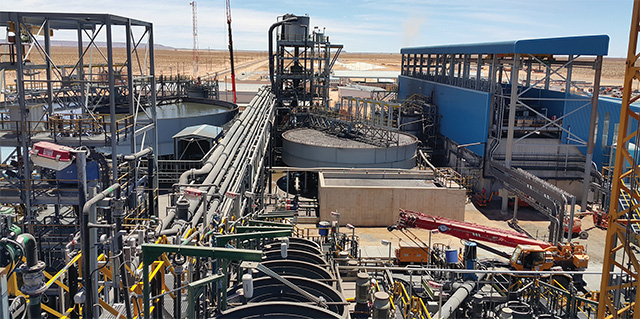
The processing plant at the Gamsberg zinc project near Aggeneys in the Northern Cape.
Meijers makes the point that one of the distinguishing features of ELB Engineering, which traces its origins back to the establishment of Edward L Bateman in 1919, is an ability to re-model itself in response to changing market conditions. As he says, “You don’t stay in business for 100 years by being traditional and inflexible. We accept that markets change and we’ve always been willing to adapt to ensure that we not only survive but also prosper whatever the business conditions.”
ELB Engineering is probably best known for executing large capital projects in the mining and power sectors with one of its most recent achievements being the delivery of the processing plant and infrastructure required for Vedanta’s Gamsberg zinc project in the Northern Cape, including a concentrator plant featuring – for the first time in Africa and the first time globally on a zinc project – Staged Flotation Reactor (SFR) technology. In the power field, it has been closely involved now for a period of years with Eskom’s new build programme, in particular the giant Medupi power station.
The problem is that work of this type is now scarce. “There are very few greenfield projects in the pipeline, especially in mining,” says Meijers. “We’re confident that mining will revive – as it always does – but, in the meantime, we’ve launched several new businesses to give us a degree of diversification from traditional markets. We call these new ventures our ‘fledgling businesses’. They’re all housed in one or other of our existing divisions where they will grow and mature. Eventually, when they’ve developed sufficiently, we see them becoming independent entities within ELB Engineering.”
As an example of a fledgling business which has already been a spectacular success for ELB Engineering, Meijers cites the case of ELB Construction (ELBCON). Established by ELB Engineering in 2011 as its in-house construction arm, ELBCON is now functioning as an independent contractor, servicing not only ELB Engineering’s needs but those of the broader industry.
“We created ELBCON to counter what we perceived to be a major loss of capability in South Africa’s formal construction industry which was starting to impact on ELB Engineering’s ability to deliver projects on time and to the requisite standard,” says Meijers. “It’s been a real winner for us and has revolutionised the way we do projects. It’s biggest project to date has been Gamsberg, where it deployed a workforce of around 800 people. ELBCON is now moving out of ELB Engineering’s shadow and starting to work for external clients.”
Turning to ELB Engineering’s more recently established fledgling businesses, Meijers says they are mostly high-tech in character. “Take, for example, Novatec SA – this is a 50/50 joint venture we established last year in conjunction with Croatian company, Novatec New Technologies, which is a leader in fields such as PLC software for automation and process management, SCADA interfaces and remote monitoring solutions via the cloud,” he says.
“We worked with them at Gamsberg and were very impressed with the quality of their work. We’re now partnering with them on a formal basis and the joint venture is able to offer a full turnkey service on electrical (MCCs) and PLC panels from design, manufacturing and programming right through to installation and commissioning. In fact, Novatec SA is the only company in South Africa with this end-to-end capability.”
According to Van den Heever, who is ELB Engineering’s Electrical, Instrumentation and Control Engineering Manager and a Director of Novatec SA, the joint venture has hit the ground running, with eight projects under its belt already, one of them in Zambia. “The business broke even within four months of being founded and we’re expecting it to become a material contributor to ELB Engineering’s bottom line within two years,” he says.
In a second high-tech venture, ELB Engineering is now also working closely with an American company, Seattle-based Kymeta, which has Microsoft-founder Bill Gates as one of its shareholders. Kymeta has introduced disruptive technology to the satellite communications space with its development of ground-breaking ‘plug and play’, flat-panel, satellite antenna technology that promises to revolutionise the field of connectivity on the move. The Kymeta™ technology overcomes the limitations of conventional satellite antennae and offers full broadband connectivity anywhere in the world, at any time, at competitive prices, especially when used on moving vehicles.
“We signed a distributorship agreement with Kymeta in 2018 and we’re now looking to roll out the technology in Africa,” says Meijers. “We see application in a range of industries, especially mining, where sites are very often extremely remote and have to rely on satellite communications. The Kymeta technology offers big advantages over conventional fixed satellite dishes. It is very affordable, very compact and can be set up within half an hour. We’ve demonstrated it to many potential customers, including mines, and we’ve had a very positive response.”
While the technologies from Novatec and Kymeta have involved overseas partners, a third high-tech offering now available from ELB Engineering is totally South African. “This particular initiative centres on some really revolutionary camera recognition technology we’ve developed in house in collaboration with local partners and which we’re patenting,” Meijers explains.
“It’s really about taking an image and analysing it via an algorithm. How we interpret the image depends on what we want to get out. To take just one example, we might have security and safety in mind, in which case we would look at the behaviour of people to see whether it is consistent with what we would expect. The applications are pretty much endless and we’ve only explored a few of them so far.”
ELB Engineering has received its first order for the camera recognition technology from one of the bigger chromite producing/recovery companies. “The order was secured after we built a demo unit to test the technology,” says Van den Heever. “The challenge was to use the technology to analyse chrome fines on a shaking table by recognising characteristics such as particle size, particle shape and colour, and then using the intelligence gained to move the splitter arm to get the optimum separation between the waste and the chrome. The trial was very successful, increasing the yield in some cases by about 22 %.”
Both the camera recognition and the Kymeta technology reside within ELB Intelligent Solutions, a company created around two years ago to ensure that ELB Engineering can offer the latest technologies – including smart plants, drone systems and solutions based on the Internet of Things (IoT) – to its customer base.
Looking at ELB Engineering’s current order book, Meijers says that the company’s power division is doing extremely well, with one of its flagship projects being the 25 MW Ngodwana Biomass Project, which is currently being erected at the Sappi Ngodwana Mill site, 40 km west of Nelspruit in Mpumalanga Province. The project is being executed on an EPC basis by the ELB-KCC Consortium which consists of ELB Engineering, KC Cottrell (KCC) of South Korea and the ELB Educational Trust and is already well into the construction phase, with the first concrete pour – for a section of the boiler building raft foundation – having recently taken place.
“This is a big contract for us and is also a landmark as it forms part of the government’s Renewable Energy Independent Power Producer Programme,” notes Meijers. ‘It is our first biomass project but there are other opportunities ahead. We see the provision of power and water as the African continent’s biggest challenges and we intend being a player in the power sector. We are working on several initiatives which will see us extending our power offering, with our target market being projects of roughly up to about 50 MW of generating capacity.”
Another success for the power side of the ELB Engineering business has been a move into operations and maintenance, which has seen the company assisting Eskom at its Medupi power station on Units 2 and 3. “In general, we’ve detected an erosion of maintenance skills in South Africa’s state-owned enterprises and this is opening a new market for us,” Meijers observes. “It’s very different to project work as it generates an annuity-type income but we see it becoming an increasingly important part of our business.”
Summing up, Meijers says that ELB Engineering has had to adapt its business model to current market conditions. “The bottom line is that if we sit around waiting for traditional markets such as mining to revive we’re going to be in big trouble. We need to diversify and we need to embrace both the challenges and opportunities of an increasingly digitalised world. We’ve managed to do this successfully so far, in the process transforming ELB Engineering into a more diversified company than it was just four or five years ago.”