In the demanding field of shaft sinking, leading global player Murray & Roberts Cementation is adapting and applying a range of technologies for working in challenging conditions – while maintaining its reputation for safety and environmental care.
The company has been a pioneer in various methodologies, leveraging its depth of experience in varying conditions around the world. Graham Chamberlain, New Business Director at Murray & Roberts Cementation, highlights that much of the progress comes from knowing which technologies can be successfully employed in a given situation.
“Innovation in our business means being inventive and judicious in our choice of technology for each specific application,” says Chamberlain. “Often the technology we employ is off-the-shelf and well-proven, but we can use it to great effect in achieving optimal project results for our clients.”
In a recent contract at Ivanhoe Mines’ Platreef project near Mokopane in South Africa’s Limpopo province, for instance, directional drilling technology was used to guide raise boring equipment to meet exacting requirements. Murray & Roberts Cementation was able to complete a 5.1 m ventilation shaft to a depth of 950 m below surface, where it intersected precisely with an existing underground excavation.
“Directional drilling is certainly not new to the market, and is readily available to anyone,” he explains. “By applying our expertise and knowledge gained over multiple projects, we know when and where to deploy technologies to enhance the solutions we design.”
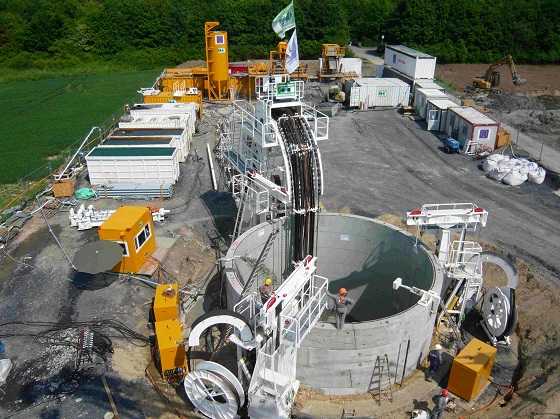
More recently, the company has been engaged in another contract to sink multiple shafts through very poor ground conditions to a depth of 280 m. There are also social and environmental impacts which must also be carefully mitigated, as the ground material is water-bearing and nearby villages use water from the same aquifer.
“In this case, the traditional techniques of cementation injection or chemical grouting were out of the question owing to the risks of groundwater contamination,” he says. “We also wanted to avoid the noise and light pollution that would be associated with certain methods.”
Among the solutions was an established water-freeze method, where drilling would take place through frozen ground. Instead, Murray & Roberts Cementation opted for a modern version of the caisson method, using a road-header that is guided downwards, sinking under its own weight.
“A steel wedge is driven down under the weight of a concrete lining, which is applied from surface and prevents any risk of water contamination,” he says. “We therefore operate in a flooded environment, proceeding until we reach competent ground – at which point the shaft can be dewatered.”
He highlights that the company’s capability has been built on decades of close collaboration with its clients and with original equipment manufacturers (OEMs) – both of whom make a vital contribution to every successful project. While clients will guide the scope and choice of solutions and technologies to be applied, Murray & Roberts Cementation works with OEMs to continuously fine-tune equipment designs.
“An important aspect of technological development in mining equipment is the feedback we give to OEMs on how we think their designs can be improved,” says Chamberlain. “Our project knowledge gives them valuable insights into the operation of machines like drill rigs, for instance, and we have a formal ‘post-mortem’ with our supply partners after each contract.”
By refining the design, Murray & Roberts Cementation is using a third generation of a certain drill rig, which now incorporates improvements to enhance safety, automation, performance and maintenance. He points out how every project delivers valuable learnings, which the company ‘gives back’ to the OEMs.
As the technology employed in shaft sinking operations changes, so must the skills capability of the teams. He highlights the role that the Murray & Roberts Training Academy plays in providing the skills of tomorrow across all the disciplines.
“Our learners and entry-level staff progress through multiple levels of training to safely bring them closer and closer to real working conditions – both for operations and maintenance,” says Chamberlain. “This includes electronic phases, moving through virtual reality tools and into state-of-the-art simulation equipment. Finally, we put them through our mock-up facilities, which realistically emulate underground environments.”
The digital age has lent itself to significant advancement of operating and management control systems, which today can gather and analyse vast quantities of data in any shaft sinking project. This includes performance and condition monitoring of equipment, to help pick up early warning signs and avoid unplanned breakdowns.
“This technology assists us in making our maintenance practices more streamlined and cost effective,” he says. “With an in-depth understanding of how our equipment is performing, we can conduct component lifecycle management to reduce our unit costs.”
Combined with its safety culture, technology has been successfully embraced in Murray & Roberts Cementation’s safety performance. It has operated for almost nine years with no fatalities, recently earning a coveted award for seven million fatality free shifts. This landmark comes after the completion of five shaft sinking projects and many thousands of development metres achieved.
Sustainability is another strategic priority for the mining sector to which technology has been able to contribute, says Chamberlain. Increasingly, attention is being paid to reducing the carbon footprint of the company, including carbon emissions associated with inputs.
“In our work we often use large quantities of concrete, and are cognisant of the energy-intensity of cement,” he says. “We therefore look for opportunities to use recycled material like fly ash as an extender in cement, to reduce the volume of pure cement in concrete for shaft linings.”
There are also carbon impacts related to the manufacture and detonation of explosives, he notes, so there is a trend towards the use of technology to bore rather than blast excavations – where ground conditions allow.