Chemical Technology • September 2013
FOCUS
on water treatment
The Institution of Chemical Engineers
(IChemE)
in the UK is predicting that
desalination plants could become more
common on UK coastlines and estuaries
by 2050 as population growth and the ef-
fects of climate change places increasing
pressure on water supplies.
Worldwide, there are around 13 000
desalination plants in operation or under
construction in 150 countries. In June
2010, the UK opened its first municipal
desalination plant in Beckton, East Lon-
don, which is operated by Thames Water
and capable of supplying 150 million
litres of water per day – enough to supply
around 400 000 households.
Conventional thermal desalination
plants, which often use fossil fuels, use
energy-intensive evaporation and conden-
sation processes to produce fresh water.
Membrane systems, most commonly
Reverse Osmosis (RO), typically use high
pressure pumps to force water through a
semi-permeable membrane, leaving the
salt behind.
The energy needed to run RO mem-
Water Purification Chemicals & Plant (WPCP)
has recently
completed a water purification plant upgrade project, as me-
chanical and electrical contractors for Umgeni Water.
“Due to the expansion of the population in the greater Ixopo
area in Kwazulu-Natal, the local water purification plant had
been experiencing serious water shortages,” says Martin Overy,
WPCP’s managing director. “Outdated filtration equipment ag-
gravated this problem and the urgency of the situation required
that the upgrade be completed in a tight three month period.
“The challenges of this contract, which entailed the refur-
bishment of the filtration capacity of the Ixopo Water Purifica-
tion Works, included a contract to strip the existing non-func-
tional pressure sand filters and replace these with new coated
steel sand filters.”
WPCP, with the assistance of the Umgeni Water plant per-
sonnel at Ixopo, process technicians and design engineers at
Umgeni Water PEF, ensured the contact deadline was met.
The upgraded plant, with three new pressure filters, now has
a filter capacity of 2 Ml/d. According to stringent Umgeni Water
specifications, the water quantity is 90 m³/hr and the quality is
less than, or equal to, 0,2 NTU (Nephelometric Turbidity Unit –
which is the measure of the clarity of a liquid).
The new filtration plant is enhanced by dedicated backwash
and backwash recovery pumps, air blowers, piping and valves,
as well as a full set of instrumentation.
The plant required automation of the entire pressure filter
system, including the design, programming, installation and
Water challenges make UK desalination plants more likely
Filtration capacity of Ixopo Water Purification Works upgraded
For further information, please contact-
Tony Osborne, communications officer,
IChemE, on tel: +44 (0)1788 534454 /
+44 (0)7802 834459
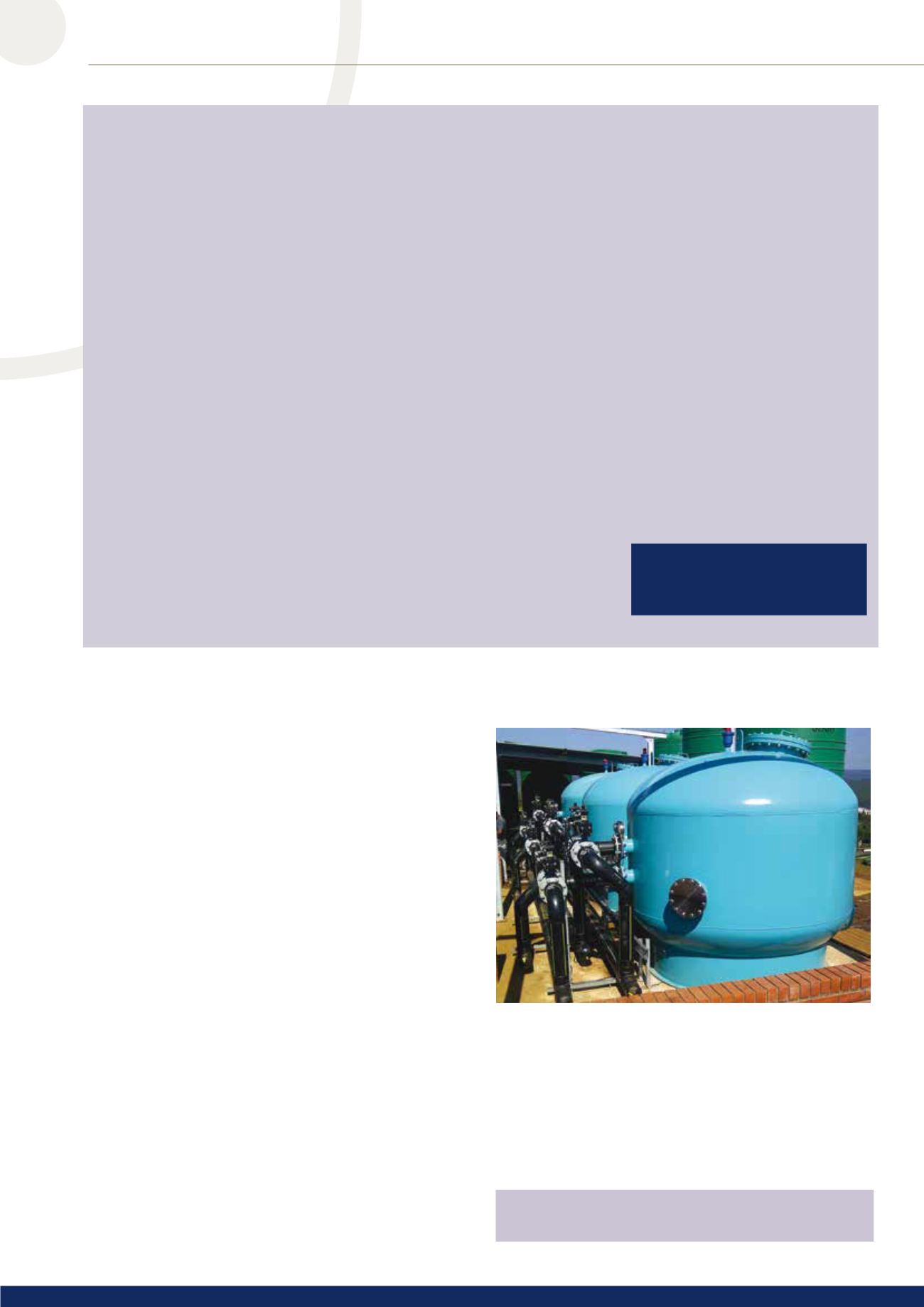
WPCP has recently completed a water purification plant project for Um-
geni Water, as mechanical and electrical contractors, for the upgrade of
the Ixopo Water Purification Works.
brane systems is proportional to the
salinity of the water. Low salinity brackish
groundwater or estuarine waters treated
by RO membrane systems therefore
require just a fraction of the energy that
thermal desalination processes would
need. However, membrane systems are
prone to fouling, and more chemicals are
required to maintain them.
Even with the latest RO membranes, the
pumping energy and chemical costs make
desalination plants much more expensive
to run than comparable non-saline water
treatment works. As a result, Thames
Water only operates its desalination plant
during periods of drought.
However, changes in technology, com-
bined with major population growth and
unpredictable weather patterns caused
by climate change are likely to make
desalination more viable in the UK. Martin
Currie, a member of IChemE’s Water
Special Interest Group and independent
water quality and treatment consultant
with Aqueum, said: “While improvements
are continuously being made to RO
membranes making desalination more
chemical- and energy efficient, some of
the most exciting developments in desali-
nation are with breakthrough technolo-
gies. Researchers are currently working to
scale-up biomimetic membrane processes
employing aquaporin proteins – found
in our kidneys – that let water through
much more efficiently than conventional
membranes.
“Also, UK universities and companies
are at the forefront of Forward Osmosis
(FO) – a technology now in commercial
operation that uses osmosis to suck water
through the membrane rather than just
pumps to push it. Both technologies prom-
ise huge energy savings and FO plants are
already seeing massive reductions in the
amount of chemicals required to maintain
the membranes”.
commissioning of a new motor Programmable Logic Controller
(PLC) and Human Machine Interface (HMI) data visualization
solutions. This also included valve actuation, pump automation,
cabling and the compilation of a functional design specification
for the system.
For more information contact Martin Overy, Managing Director,
on tel: +27 31 502 3310; email:
;
or go to
26


