materials of construction
32
Chemical Technology • September 2013
The formation of WO
3
as a film accounts for WC-
VC-Co pseudopassive behaviour in acidic test media,
and in the current study, the observation of pseudo-
passivity in the neutral 1M NaCl test solution (Figure
1).Its formation on the specimens tested in SMW was
however not accompanied by pseudopassive. The dif-
ference in pseudopassive behaviour between the NaCl
and SMW could have been caused by the difference
in Cl
anion concentrations, where the higher concen-
trations in NaCl encouraged passivation compared to
the low concentration obtained in the SMW. It is also
possible that the WO
3
film formed in SMW had poorer
adhesion properties.
General discussion
The results in this study indicate that the effect of
increasing amounts VC on the corrosion resistance
of WC-Co was electrolyte dependent: VC reduced the
extent of the pseudopassive behaviour in NaCl but
did not change it in SMW; it did not alter the corrosion
current density in NaCl, where the current density
increased with Co content, while it reduced it in SMW;
and chronoamperometric current densities stabilized
at higher values for specimens with VC. In the overall,
the results indicated that VC impairs the corrosion
resistance of WC-Co except in SMW where it reduces
the current density. These results can be explained
from two perspectives.
In general, it can be expected that VC additions af-
fect the corrosion resistance of WC-Co in two ways. In
the first instance, vanadium atoms from the VC can go
into solution in the Co and either on their own and/or
in conjunction with W atoms that also go in solution in
the Co, alter the corrosion resistance of the Co. Solute
atoms of W improve the corrosion resistance of Co.
This effect can either be augmented or curtailed by
the presence of VC through its effect on the quantity
of W atoms going into the Co. The W solute content in
Co can be determined from the magnetic saturation,
since, broadly, the magnetic saturation of conventional
WC-Co increases with decreasing amounts of W atoms
in Co. Judging from the magnetic saturations of the
test specimens, which increase with VC content (Table
1), the introduction of VC reduced the amount of W
atoms in the Co binders of these specimens.
The reduction of the W solute content of the Co of
the VC specimens deduced above explains a number
of the observations in this study. Some authors have
used the W solute content, captured in the magnetic
saturation, to explain the corrosion behaviour of WC-
Co. According to literature, a low magnetic saturation,
implying a higher W solute content of the Co binder,
is associated with a more pronounced pseudopassive
behaviour in sulphuric acid. The pronounced pseu-
dopassive behaviour observed for specimen 0VC in
NaCl in the current study (Figure 1) can therefore be
Table 4: Raman shifts after corrosion in NaCl
Specimen Raman bands Possible phase References
WC-10C
133 & 249
814.5
679 & 958.5
WO
3
WO
3
WO
3
·
2H
2
O
[16]
[17]
[16]
WC-0.4VC-
10Co
131
697
813.5
881.5
968.5
WO
3
WO
3
WO
3
WO
3
·
nH
2
O
WO
3
·
2H
2
O
[16]
[18]
[17]
[19]
[16]
WC-10VC-
12Co
131 & 803
261 & 962
WO
3
WO
3
·
2H
2
O
[16]
[20]
WC-27VC-
11Co
132.5, 262.5,
700, &805.5
WO
3
[16]
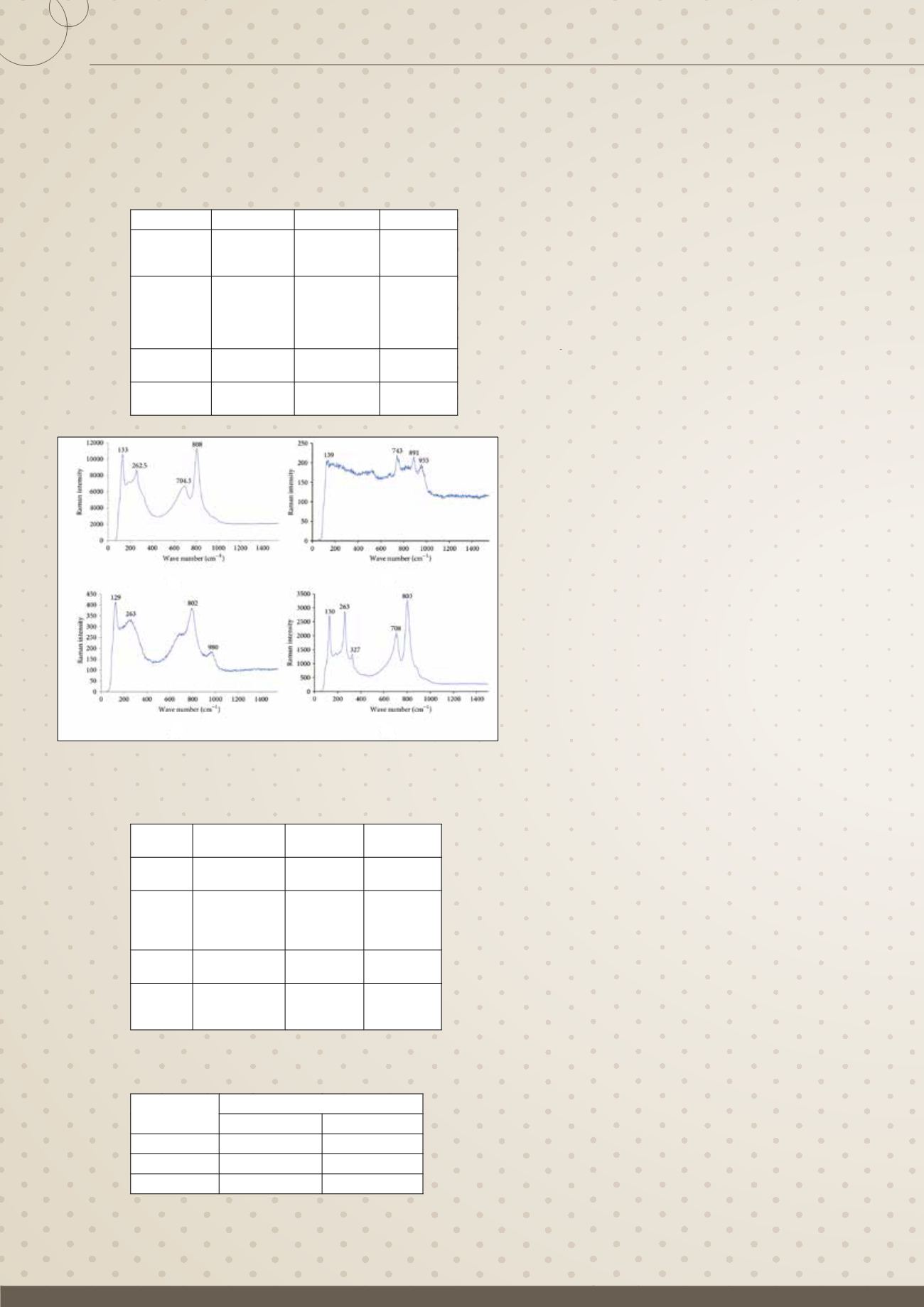
Table 5: Raman bands after corrosion in SMW
Specimen Raman bands
Possible
phase
Reference
WC-10Co
133, 262.5,
704.5 & 808
WO
3
[16, 21]
WC-0.4VC-
10Co
139
743
891
955
WO
3
Cubic WO
3
WO
3
WO
3
·
2H
2
O
[21]
[20]
[19]
[16]
WC-10VC-
12Co
129, 263, & 802
980
WO
3
WO
3
·
nH
2
O
[21]
[22]
WC-27VC-
11Co
130, 263, 708,
& 803
327
WO
3
CaWO
4
[21]
[19]
Table 6: ICP-OES results of VC containing corrosion product solu-
tions after dissolution in SMW and NaCl
Sample
Vanadium content (ppm)
SMW
NaCl
WC-0.4VC
46.7±1.3
83.1±3.5
WC-10VC
15.1±3.7
24.9±2.7
WC-27VC
58.4±3.1
2.0±0.3
(a)
(b)
(c)
(d)
Figure 9: Raman spectra of after corrosion in SMW a) WC-10Co,
b) WC-0.4VC-10Co, c) WC-10VC-12Co, and d) WC-27VC-11Co.


