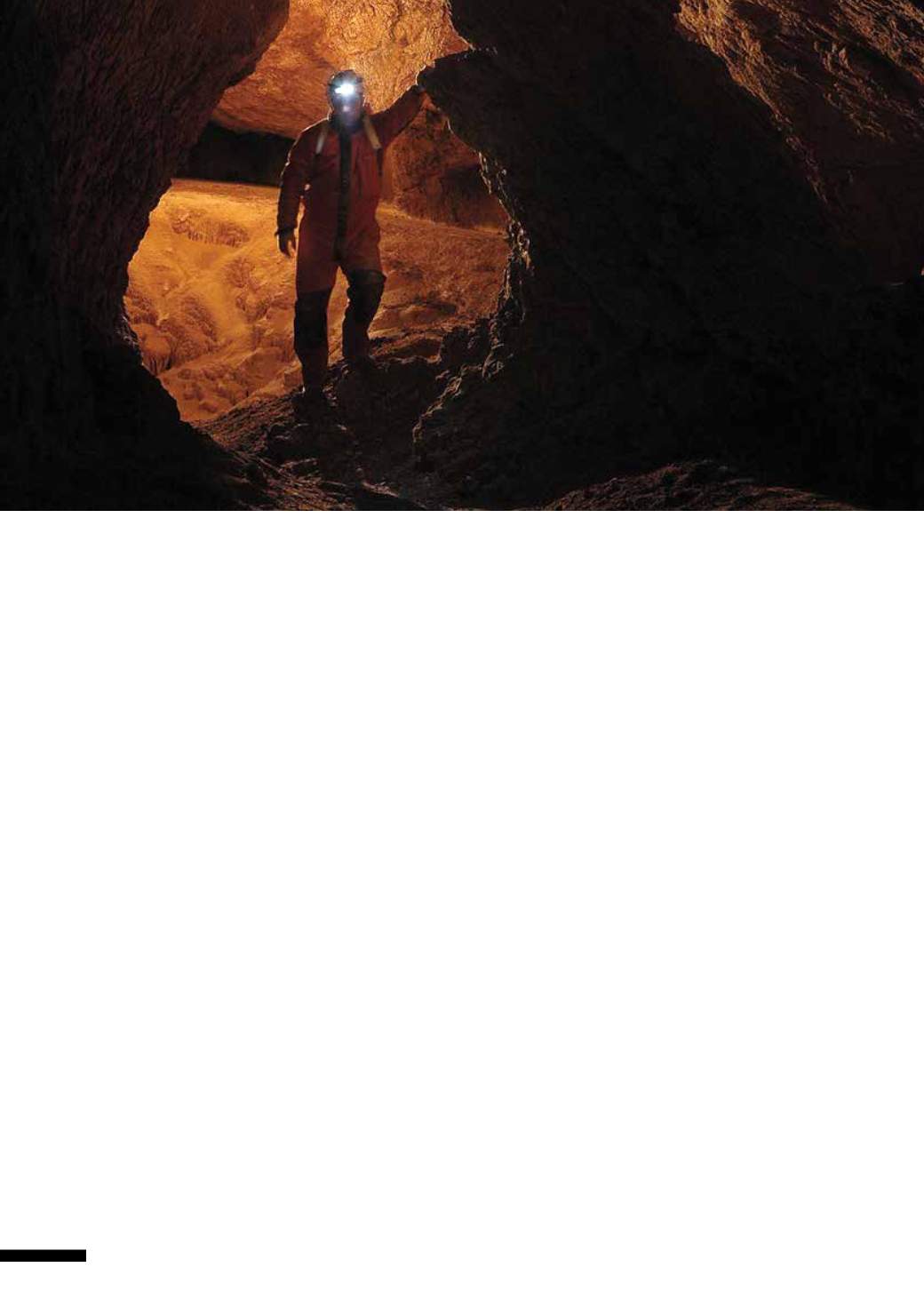
based in Canada, produce an integrated cap lamp
with both the LED and lithium-ion battery in a single
enclosure.
While it is true that the brightest LEDs available
today produce a bluish-green light, sacrificing some
luminance by coupling them with phosphors will
produce white light with good colour rendering.
LEDs produce about 125-130 lumens per watt, with
200 lumens per watt coming onto the market, and
future versions being able to produce equivalent
light levels to 400 W high pressure sodium flood-
lights. Dialight, a US-based firm, has just released
its Vigilant High Bay integrated LED fitting, offering
60 000 lumen output from a 480 W supply. It is
targeting the replacement of traditional 1 000 W
high intensity discharge lamps.
Manufacturers are taking advantage of LED
versatility. They can be configured to produce any
horizontal or vertical light distribution.They’re resis-
tant to shock, vibration and corrosion.They provide
instant on and instant restrike capabilities, down to
-40°C, with no warm-up time to full brightness.They
are rated for use in areas with flammable gases.
They are also exceptionally efficient.
More importantly still – for anyone who has
worked under bright incandescent factory lighting
– LEDs produce very little heat and no ultraviolet
or infrared radiation.
That said, LEDs in industrial applications are run
from ac power-sources. This requires an external
driver to step the power from ac to dc, and drop
the voltage from 120/240 Vac to 24 Vac. These
T-junctions release a tremendous amount of heat,
which can degrade LED performance and life-span.
If not properly managed this also limits the ap-
plication of the LED, preventing use in countries
with high heat and humidity (anywhere in the
Middle East) or specific industries (smelting or
casting). Large heat sinks are usually attached to
the T-junctions to draw and dissipate heat.
All of these considerations come into play in
the extreme environment of a die-casting factory.
Dirt, dust, grease and heat all require management.
Frequent cleaning with high power water jets is es-
sential to maintain the quality of the castings and
hazardous for electrical lighting.
Dust and contamination coat lamps and degrade
luminance.Testing conducted at MIT indicates that
lighting in such environments loses up to 28% ef-
ficiency per year from luminaire dirt depreciation
(LDD).The traditional way of solving this problem is
simply to install more lighting fixtures. More recent
developments are to install entirely enclosed light-
ing units that are dust-tight and waterproof during
high-pressure cleaning.
Other environments require protection against
people. The London Underground is both dirty and
filled with angry commuters. Lighting needs to sur-
vive heat, humidity, particulate dust from train brak-
ing, and people attempting to vandalise the fixtures.
Such anti-ligature lighting requires tamper-proof
screws, tough components and flush-fitting diffus-
ers. Prison lighting, similarly, must prevent harm to
prisoners and staff. It shouldn’t be possible to crack
the light fitting diffuser and use it as a weapon, for
instance. It must also survive something euphemis-
tically described as ‘naked flame attack’.
Submarine lighting combines high-pressure with
vast amounts of briny water. Here LEDs are making
inroads against halogen lights, offering equivalent
dimming range. With remotely operated vehicles
exploring to depths kilometres below the surface
LiD
08-09/14
28


