as mining companies explore new resources or
tight oil sources, lighting must survive impossible
pressures. It must also be field-replaceable. Con-
nectors need to be serviceable in minutes, and
lighting compartments isolated from the connector.
When James Cameron went to the bottom of
the Mariana Trench in 2012, there was no way this
filmmaker was coming back without pictures. Even
at 11 kilometres down, lighting had to work.
Perhaps this still doesn’t impress you? How
about a nuclear power plant? This is an environ-
ment that has it all. Emergency lights must survive
plant meltdown, earthquakes and other disasters.
After that they must provide days of illumination as
emergency workers attempt to restore safety. Dur-
ing that period they must survive any contamination
that the plant can throw at them; from humidity to
acids and corrosives, to nuclear waste.
Under normal operating conditions, nuclear
plants require fuel pool lighting, reactor core refuel-
ling lights and underwater camera lights.
These are all systems, though, where the light-
ing is supplied and produced exactly where it is
needed. There are some places where it is too
hazardous and too confined to insert an entire
lighting enclosure: the human body.
Certainly, surgical wards require lighting that
can be sterilised, but minimally invasive surgery
requires lighting that can be fed into tiny incisions
in the human body via laparoscopes.
The approach here is to generate the light in a
separate unit then deliver it via optical fibre. This is
known as fibre delivered lighting, or off-board illumi-
nation. Not only does it minimise the physical size
of the final light delivery point, but it removes any
source of heat or electricity to a remote location.
The fibres can be 10 to 25 mm in diameter and,
while effective, can be fragile. An alternative is to
use sheaths filled with clear optical gel. These use
a quartz end to transmit the light into the cable and
are susceptible to breakage.
The difficulty with optical cable is that total inter-
nal refraction means that light emits as a point at
the far end. In 2013, in a paper published by Stephan
Logunov, et al at the Science and Technology Divi-
sion of Corning (the folks behind Gorilla Glass), they
present a mechanism of embedding a thin silica
core inside a fibre to engineer light scattering. That
means that an area can then be lit.
The applications can go well beyond the medi-
cal field.
Consider that laser diodes are relatively inex-
pensive and that different phosphors can permit
exact tweaking of the light colour. The fibres can
be as thin as 100 microns in diameter with minimal
losses even with bending diameters as small as
5 mm in radius. Logunov says they demonstrated
coupling efficiency of approximately 50% relative
to LED sources.
Lighting that can be delivered remotely from the
light source via long and flexible fibre-optic cable
offers an entirely new approach to lighting extreme
environments. The light source can be removed
from danger entirely. This can massively reduce
costs, even as overall luminance is improved. It can
also change everything we think we know about
lighting, which seems to happen quite often.
The first endoscopic surgical lighting was in
1585 when Aranzi focused sunlight through a flask
of water and projected it into the nasal cavity of
his patient. 1853 saw Antoine Jean Desormeaux’s
development of the Lichtleiter, an aluminium tube,
mirrors and a wax candle focusing light to perform
endoscopy.
Our need to light extreme environments has
been a constant source of innovation. Whether it
be our pursuit of valuable minerals deep beneath
the earth or our determination to cure disease and
injury, each complex and hazardous constraint has
propelled our technology forward. We’ve come a
long way since Aranzi and even LEDs don’t appear
to be a final lighting destination.
As we mine ever deeper and investigate ever
further, our need to light dark places will go with us.
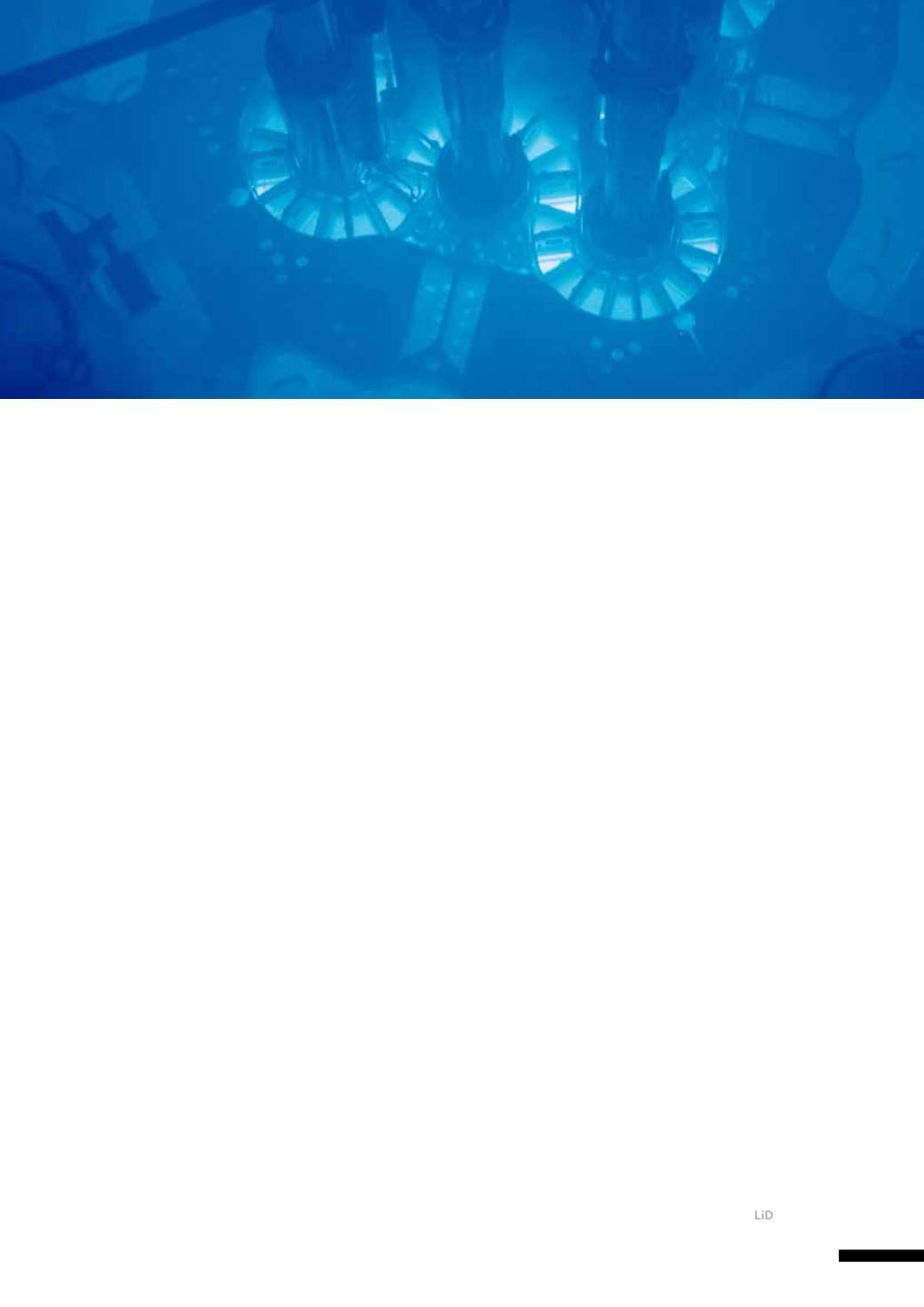
Advanced test reactor core, Idaho National Laboratory.
29
LiD
08-09/14


