18
Mechanical Technology — August 2013
⎪
Materials handling and logistics
⎪
O
n May 28 at a function at
its Longmeadow facility in
Johannesburg, ABB, the
power and automation tech-
nology group, announced the arrival of
the VM3D Volumetric Laser Scanner,
designed to measure the volume of bulk
materials stockpiles in the open, in large
silos, bunkers, domes, sheds or cylindri-
cal vessels. “The original concept for this
product was developed in South Africa,”
says Nadia Nilsen, ABB’s local Measure-
ment Products business unit manager.
“So I am proud to introduce the final
result today, a global ABB product with
South African roots,” she reveals.
The VM3D measures the topography
of bulk materials stockpiles, regardless
of the material, the complexity of the
stockpile or the structures that may be
in the path of the scanner. Typical ap-
plications are inventory measurement
of sugar, fertilizer, mineral ore, coal,
potash, biofuel and chemicals for either
accounting or process purposes.
Describing how the lasers collect
data, Nilsen says that the system uses
a time-of-flight
ca l cu l a t i on t o
determine a dis-
tance between the
lasers and the top
surface of a stock-
pile. “The laser
sends out a pulse
from the module
to the target sur-
face. On reach-
ing material, the
reflected beam
is diffused, but
some of the pulse
always comes di-
rectly back into
the laser receiver,”
she explains. The elapsed time between
sending the signal and receiving its
reflection is then used to calculate the
distance to the stockpile.
“From the simple equation, distance
equals speed times time, and because
we know that the speed of light is
300 000 km/s, we can easily calcu-
late the distance to the stockpile. The
genius is the ability to use electronics
to measure such very short times,” she
suggests – time differences in the order
of 3,33
µ
s/m.
“The lasers emit a beam of about
20 mm in diameter, but the beam only
diverges by 0,3% so the beam that
comes back is almost the same width
as that initially transmitted. The beam
is also tolerant to dust or fog. The last
measurement to bounce back is taken
as the target measurement, so partial
reflections of dust or fog are ignored,”
Nilsen explains. “Generally, if you can
see the stockpile through the dust, then
the laser can measure it.”
On the safety side, she adds that the
laser beam, at 905 nm in wavelength,
is invisible to the naked eye and with
an IEC class 1M rating, it is completely
safe to the eyes. “The only way to make
it unsafe is if you look directly into the
beam using a telescope or a pair of
Volumetric scanning for stockpile
Nadia Nilsen.
The VM3D Volumetric Laser Scanner scans a stock-
pile, collects point cloud data and sends it via a net-
work cable to a control box. The controller collates the
data, encrypts it and sends it via a 3G data network to
the ABB data centre.
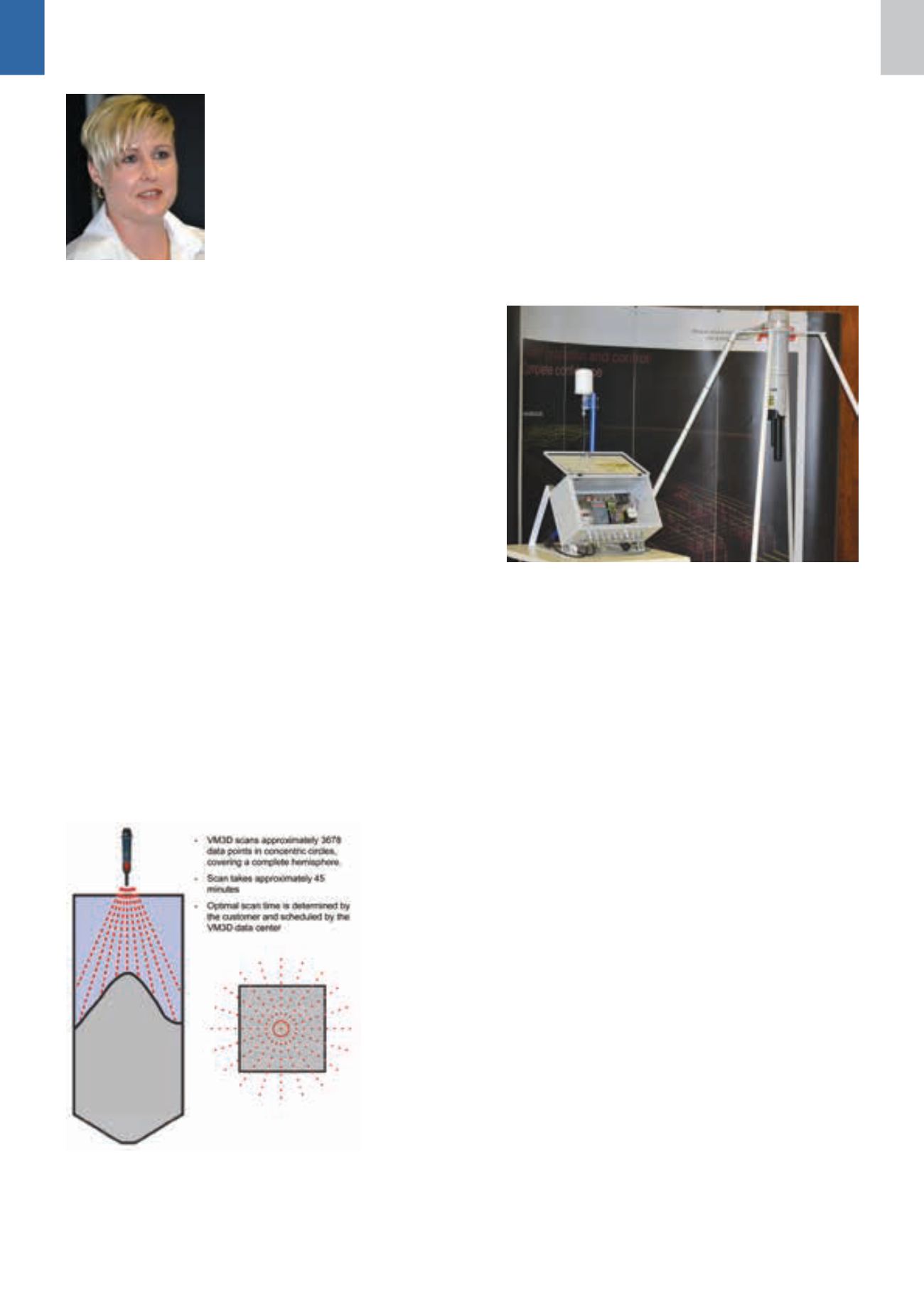
The VM3D scans approximately 3 678 data points in concentric
circles, covering a complete hemisphere. Because of the non-
diverging nature of laser light, it is tolerant to the sidewalls of
bins and to fog, dust and other obstacles.
ABB South Africa, through its Measurement Products business unit, has introduced the
VM3D, a new 3D volumetric laser scanning system and service for stockpile inventory
management. Originally pioneered in South Africa, the system handles complex surfaces
and offers accurate inventory measurements in confined silos, large warehouses or outdoor
stockpiles.
MechTech
reports.
binoculars,” she assures.
Describing how the system works,
Nilsen explains that the starting point is
a materials stockpile, inside a bin, in a
shed or a warehouse, or in the middle of
a field. “The scanner scans the stockpile
and creates a point cloud, which is a
huge number of points that each relate
to an exact distance of the stockpile
surface from the scanner. Multiple scan-
ners can be used to measure the same
stockpile, should all round access be a
problem,” she adds. The point cloud
data collected is sent via a network
cable to a control box. This controller
collates the data, encrypts it and sends
it via a 3G data network to the ABB data
centre. When the data centre receives
the point cloud, an ABB analyst takes
over. Up to that point in time, everything
would have happened automatically.
“The scanner cannot recognise when a
front end loader is parked in the middle
of the stockpile, for example, and the
idea is that we offer you data with the
maximum possible accuracy. So we
need people to identify obstructions that
do not make up the stockpile itself, and
to remove them before the volumetric
analysis is done,” says Nilsen. “This
human intervention is what makes this
product and service offering so uniquely


