Mechanical Technology — August 2013
17
⎪
Proactive maintenance, lubrication and contamination management
⎪
M
any hydraulic and pneu-
matic system problems
are caused by fluid con-
tamination and, by con-
trolling this, operators can extend
component life, help maintain system
efficiency and correct faults before
these lead to unscheduled downtime
and expensive repairs, says Abraham.
“With advances in technology pro-
viding new means of assisting with
maintenance, it is important for op-
erators to make use of these, including
those offered by the latest generation of
lubricants. When properly maintained,
these lubricants have the ability to re-
duce wear and corrosion (and thereby
prevent fluid contamination), protect
the equipment, and ensure that systems
start up quickly and operate at the
correct level of precision,” he explains.
“Most fluid power circuits use either
hydraulic fluid or compressed air to oper-
ate and while these systems are similar,
both have unique operational needs
in many respects,” he says. “Although
pressurised fluids act in certain ways
in most instances, there are situations
where gas-type fluids don’t perform as
their liquid counterparts do. For example,
a pneumatic actuator cannot hold its
position against increasing external
forces as the air in the system can be
compressed further. No matter which of
the systems is in place in one’s factory
or operation however, proactive mainte-
nance – including lubricant maintenance
– will allow for the routine detection
and correction of root causes that could
otherwise lead to equipment failure.”
He cites hydraulic systems as an
example. “One of the most common
causes of failure is fluid contamination.
This is often as a result of cavitation –
the formation of bubbles within liquids.
Cavitation usually happens when the
volume of fluid demanded by any part
of the circuit is more than the volume
of fluid being supplied. As a result, the
While routine maintenance and inspection should form part of daily
operational procedure, Raymond Abraham, commercial marketing
manager at Shell South Africa maintains that this needs to include
proactive lubrication management.
absolute pressure in that specific part
of the circuit falls below the vapour
pressure of the hydraulic fluid, creating
vapour bubbles within the fluid. These
implode when compressed, making a
‘knocking’ sound. If left unchecked,
cavitation can cause metal erosion and
subsequent damage of certain hydraulic
components due to contamination of
the hydraulic fluid. As such, cavitation
can potentially cause major mechanical
failure of either the pump or motor in
the long-term,” explains Abraham.
While there are a number of factors
that can lead to cavitation (and subse-
quently fluid contamination), it’s impor-
tant to note that using a low-performing
hydraulic lubricant is one of them.
“This is because poor quality hydrau-
lic oils can’t withstand the changes in
temperature or the variations in work-
ing conditions that these systems are
usually subject to. Viscosity – and the
ability of the lubricant to maintain low
viscosity – is thus critical when it comes
to preventing fluid contamination. From
a proactive maintenance point of view,
it then becomes imperative to analyse
the properties of the lubricant being
used by one’s system so as to determine
how one can control this operational
variable,” he says, adding that there is
good news for operational managers.
“The latest generation hydraulic
lubricants do allow for effective control
of cavitation and subsequent fluid
contamination as a result. Shell Tellus
for example, has been developed as a
‘variable temperature’ hydraulic oil. This
means that it maintains its viscosity
across a wide range of temperatures. It
also contains new polymer technology,
which sees heat-activated polymers en-
sure that the oil retains the correct vis-
cosity when its temperature increases
after a cold start-up. The polymers ad-
ditionally have very high shear strength.
This keeps them stable and ensures that
viscosity is maintained even under high
Proactive lubricant management:
increasing control of variables and reducing costs
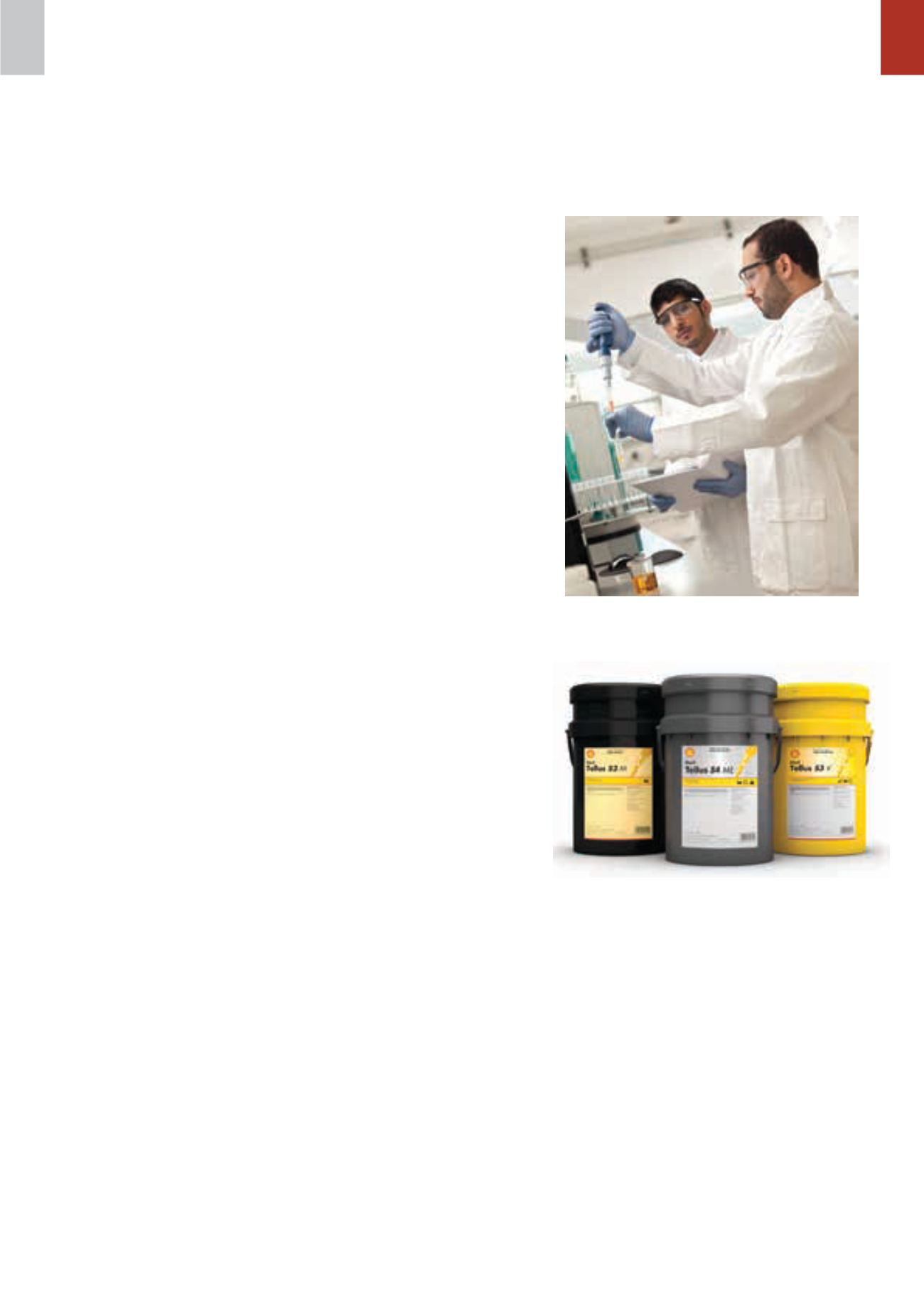
Above:
Shell oil analysis laboratories support Shell’s
LubeAnalyst programme, a condition monitoring
service to help keep equipment healthy.
Below:
Shell
Tellus variable temperature hydraulic oils.
loads. These hydraulic oils can be used
in a wide range of applications such as
lifts and cranes, high-precision presses,
off-road vehicle hydraulics, diggers and
earth movers, as well as in open-cast
mine machinery,” he explains.
Equally good news is that technolo-
gy-leading suppliers of these lubricants,
including Shell will assist in the proac-
tive maintenance of their hydraulic oils
in these applications.
“This can be done through a variety
of means including matching the correct
lubricants to the operational environ-
ment and regular oil analysis. Through
this type of partnership, one can thus
reduce the cost of one’s hydraulic sys-
tem’s operation, as well as cut mainte-
nance costs and reduce downtime.”
q


