Mechanical Technology — August 2013
15
⎪
Proactive maintenance, lubrication and contamination management
⎪
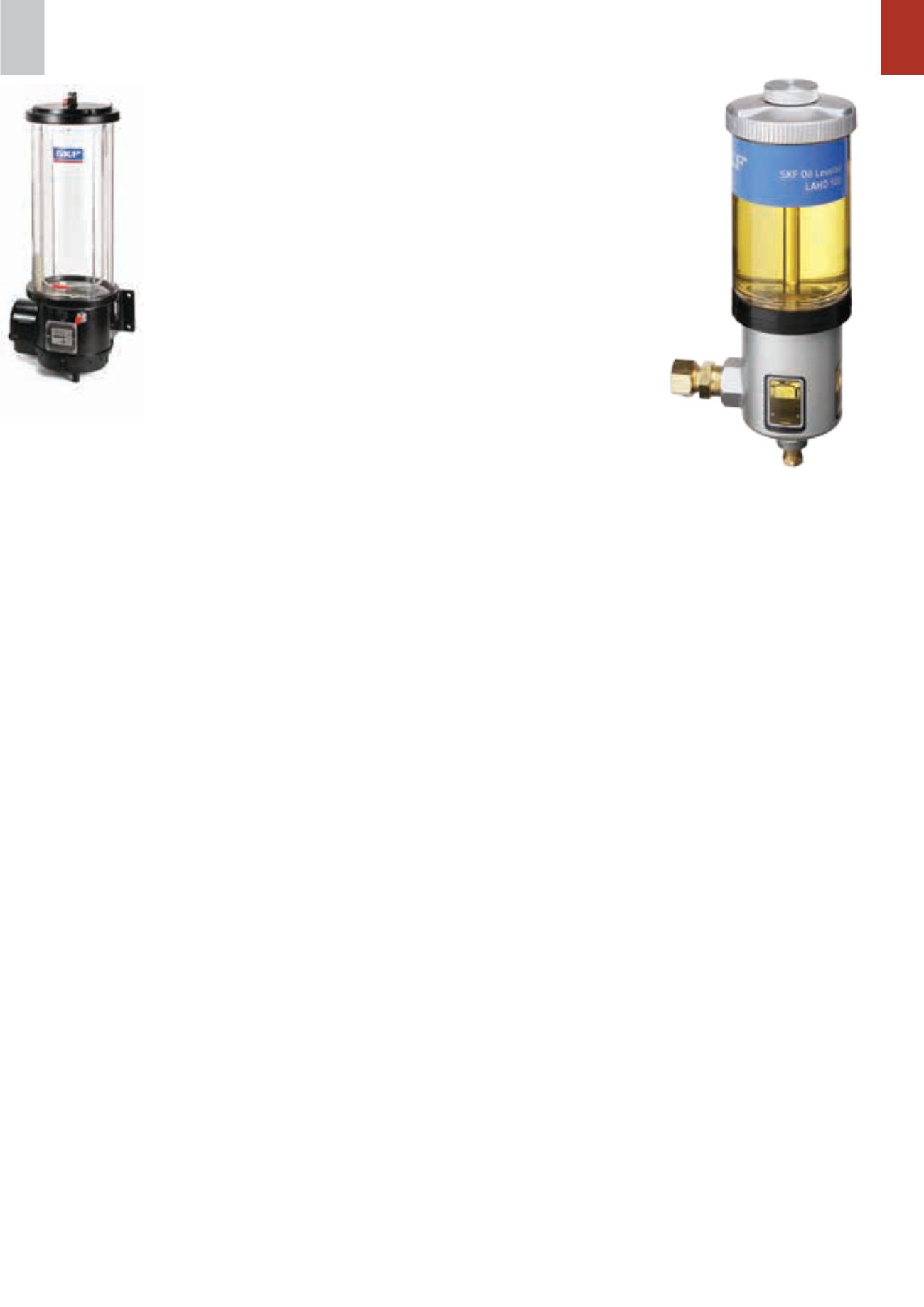
SKF
Oil Levellers
are designed
to automatically
optimise the lubricating oil level
within a bearing housing, gear-
box, crank case or similar oil bath
lubrication application.
and the bearing to lubricant
starvation conditions. On
the contrary, shortened re-
lubrication intervals with
adjusted quantities would
maintain the lubricant’s ef-
fectiveness.
Just to illustrate this in a
different way, consider that
on average, a human
being requires about
2 000 calories per
day. Would consuming
14 000 calories once a
week be suffice?
Cleanliness:
Lubricant contami-
nation will also affect bearing life and
increase the risk of failure. In manual
lubrication programmes avoiding grease
contamination can be a challenge.
Processes must be clean to ensure no
contamination ingress to the grease,
and each lubrication point must have
a cap on its grease fitting.
In the example above, the techni-
cian will re-lubricate the given point 52
times a year. As a result the bearing has
the potential to be exposed 52 times to
external contamination, over or under
lubrication.
By comparison, a properly installed
single point automatic lubricator such
as SKF SYSTEM 24 will supply a cor-
rectly timed and accurate flow of fresh
and clean lubricant, keeping the ap-
plication in proper condition, while at
the same time preventing contaminant
ingress.
Labour saving:
Certainly, the simple
manual task of pushing a lever on a
grease gun to provide manual lubri-
cation can be easily replaced by a
machine. However, as highlighted in
our discussion about the maturity of
a maintenance strategy, the real ques-
tion is – are your getting the maximum
value from your skilled maintenance
technicians? Such personnel can man-
age a lubrication programme, through
for example:
• Continuously improving the lubrica-
tion routes (refinement of the 5 Rs).
• Implementing lubricant analysis
programmes.
• Implementing contamination control
and oil reconditioning programmes.
• Implementing leakage control pro-
grammes.
Deploying automatic lubrication sys-
tems can free technicians from time
consuming basic activities to deliver
these added-value programmes.
Environment health and safety:
A
complementary perspective arises when
considering the impact of improper
re-lubrication activities on the environ-
ment. Consider again the grease waste
calculations in the example above.
Now try to estimate the impact of this
waste on the environment. Naturally it
depends on the disposal practices you
have implemented at your facilities,
but in basic environmental terms this
is simple: the less waste, the better.
Additionally, consider points of dif-
ficult or even hazardous access and
the potential impact to your personnel.
This is another area where automatic
lubrication systems offer real benefits.
Typical problems that
jeopardise the benefits
The mere fact of using technology and
automation doesn’t guarantee complete
success by itself. Technology must be
considered simply as an instrument to
achieve a goal. Basic decisions and
activities still must be performed. The
following are typical mistakes that can
jeopardize the potential benefits of de-
ploying automatic lubrication.
Install and forget:
Having an auto-
matic lubrication device doesn’t mean
that the systemwon’t require any inspec-
tion. Regular inspection will help de-
liver the best results from an automated
system. Inspection will help to identify
installation issues (damaged fittings,
leaking or blocked pipes, lubricators
not dispensing at the right pace, etc),
and indicate when it’s time to change or
refill lubricants. As a result, inspection
is required at an adequate frequency.
Use any grease without consider-
ing the application:
As a fundamental
in any lubrication programme, the
lubricant selection must precede the
lubrication system selection. After all,
the lubricant that goes into the applica-
tion is what lubricates, not the delivery
system itself.
The lubricant and the automatic
lubrication device must complement
each other and ensure a better overall
performance. Not all lubricants are
suitable for all automatic lubrication
systems, and conversely, the impact of
a lubrication system on the structure of
the lubricant depends on the technology
of that given lubrication system.
Consequently, parameters like
pumpability and oil separation must be
taken into account when
a given automatic lubri-
cation system is to be
installed. Furthermore,
re-lubrication intervals
must be defined in a way
that prevents the lubricant
from being stationary in-
side the lubrication ducts,
especially when exposed
to extreme temperatures
that could promote pre-
mature degradation.
Failure to un-
derstand and
act on these
issues can af-
fect the per-
formance and
a s s o c i a t e d
benefits of de-
ploying an au-
tomatic lubri-
cation system.
Investment cost:
Of course, deploy-
ing an automatic lubrication system
requires some level of investment.
However, to maximise the return on
that investment, the key is to choose
the right solution – based on the
requirements and criticality of the ap-
plication. Typical solutions range from
inexpensive single point automatic
lubricators (such as the SKF SYSTEM
24) to very complex centralised systems
with various options for online monitor-
ing. Determining which option is best
for your application depends to a great
extent on your criticality analysis, as
discussed earlier.
So, when should you use
automatic lubrication?
Automatic lubrication is certainly not
the solution to all your lubrication is-
sues. It has to be properly understood to
boost its potential benefits and in many
cases, those benefits can be reduced
by a lack of sufficient knowledge about
the topic.
There are solutions available in the
market for almost all applications, and
it is difficult to imagine that a critical
application is not worth equipping with
an automatic lubrication device.
Single point automatic lubricators
(such as SKF SYSTEM 24) help to keep
the investment low, while providing
flexibility for large numbers of points
spread over large areas and/or requiring
different lubricants.
q


